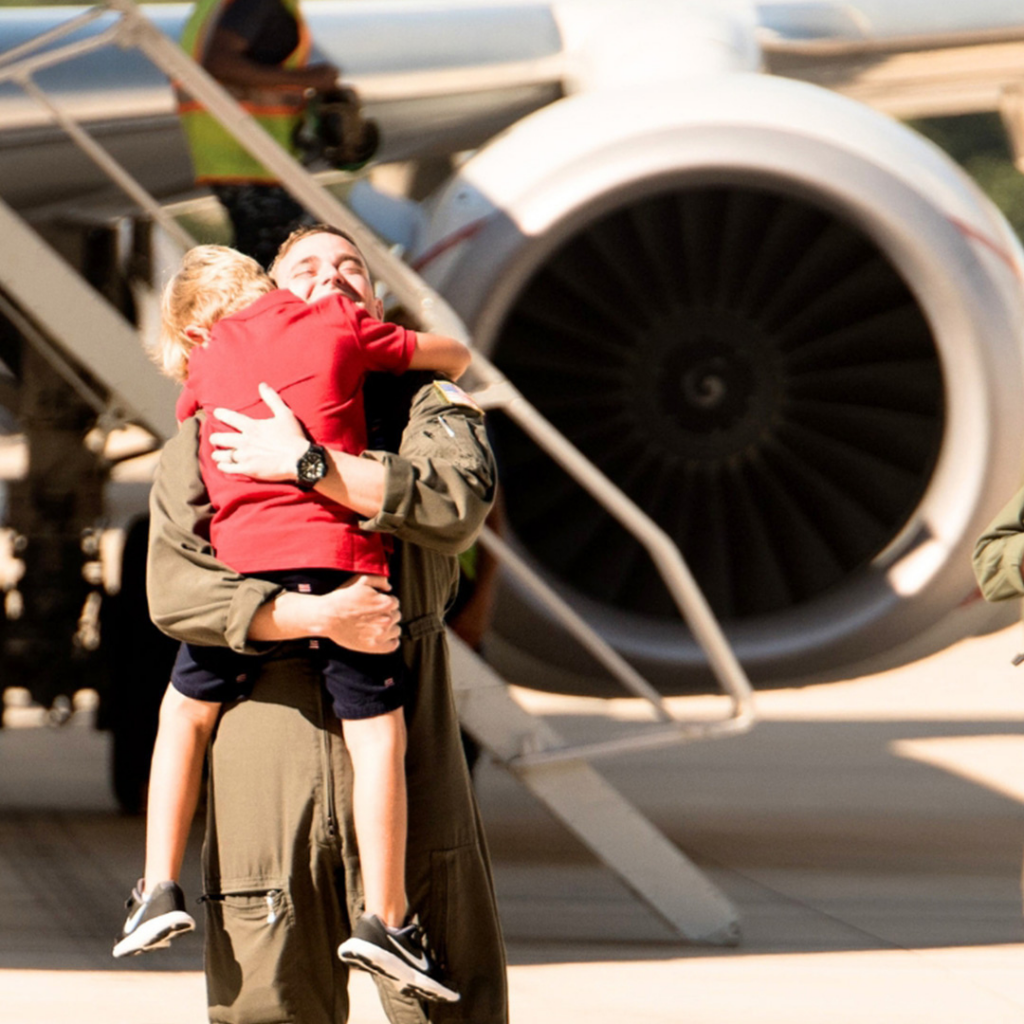
“Yesterday they were active duty, and today they are a veteran.” That’s how Susan Messina of Blue Star Families describes the moment a service member leaves the military. Their status changes overnight, and so does the life of the veteran.
This Veterans Day, much of our giving will rightly focus on the individuals who served. But among the people who help a veteran succeed during and after service are the ones standing right beside them: the spouse who has made many sacrifices already, often including disrupted (or lost) careers and lack of community roots due to frequent moves, and the children who have repeatedly started over at a new school without friends.
The hardest stretch, Messina says, is the roughly 18 months after leaving service, when the military structure that organized family life can disappear at once. Spouses lose the networks and identity built around military life. Families renegotiate roles just as financial pressure and healthcare gaps peak.
“We tend to talk about this as one person’s transition,” she says. “It’s really a whole family’s transition, happening on every front at once.”
In her view, the family is often the deciding factor in whether a transition succeeds. A veteran facing a job search, a new healthcare system or a mental health struggle is far more likely to thrive when a spouse has support and the children are adjusting well. When the family frays, it shows up in the veteran’s ability to hold a job, seek care and stay connected.
Blue Star Families was founded by military spouses in 2009. It began with active-duty families and now serves what it calls military-connected families, including those in the early years of transition. In addition to providing on-the-ground services in chapters around the country, the organization builds strong networks to help military-connected families, including a robust research arm.
The Research
Blue Star Families’ research helps explain why these networks matter and what concerns families most as they transition. In its 2025 Military Family Lifestyle Survey, 40% of veteran family respondents identified understanding of military and veteran issues among civilian communities as a top concern. Its local chapters work to bridge that divide, bringing military-connected families and civilian neighbors together to build relationships and a stronger sense of belonging.
The survey also shows how difficult transitions and financial strain can overlap. Among veteran family respondents who described their transition as difficult, 39% reported they were just getting by or finding it difficult to get by financially, compared with 17% of those who described a smooth transition. For donors, these findings reinforce the value of looking beyond a veteran’s first job after service to the broader circumstances of the family.
How Philanthropy Can Help
Blue Star Support Circles, peer cohorts for military and veteran families focused on suicide prevention, show how building community can help families support one another. One participant described being alone and in a vulnerable moment, and said that without the program, “I wouldn’t have caught some of the signs within myself.” He was able to tell his wife he was struggling and reach out for help. For him, the program helped turn a moment of isolation into an opportunity for connection.
But support like this does not reach every family. Messina points to two gaps: how organizations reach transitioning families and how programs are designed.
Community organizations have no consistent way to reach families before they leave military installations. Help often comes after military separation, when families are harder to find and already navigating the transition. Most programs also focus on the individual service member, with family support treated as secondary. Funding structures reinforce that approach by counting veterans served rather than families supported.
“That’s not a failure of will,” Messina says. “It’s a structural design problem.”
Public funding, meanwhile, is typically tied to specific, pre-approved activities and measurable outputs. That can make it difficult to fund programs that address several family needs or test new approaches. Philanthropy can help organizations develop those programs and evaluate what works.
Research is a good example. Blue Star measures outcomes such as reduced social isolation in its federally funded outdoors program, which teaches families camping skills and ends with group trips. But Messina says it still lacks the funding for a longitudinal study that would follow families over time and show which kinds of support lead to stable, lasting transitions. That is the kind of evidence-building a donor can underwrite, and it would benefit the whole field, not just one organization.
The veteran is the visible face of the need, so that is where most dollars go. But a spouse’s well-being, a child’s adjustment and a family’s sense of community are part of how a successful transition happens. Funding the family is funding the veteran. This Veterans Day, gratitude can reach further when it includes the family beside the veteran.
Philanthropy Roundtable honors the work of veterans by advising donors to direct more private philanthropy to organizations serving veterans. Blue Star Families is just one example of many that donors are investing in. Please contact Senior Director of American Values & Policy Philanthropy Clarice Smith to learn more about strategic giving to veterans.
