Through the Roundtable’s higher education donor services and “Top 10 Tips for Higher Education Funders,” the Roundtable delivers measurable campus reforms by funding initiatives that strengthen free speech protections, expand access and opportunity, and advance academic excellence. The Roundtable equips donors with expert counsel to achieve concrete results through the most effective organizations restoring American values in higher education. If you have questions or would like further support in your giving to higher education or other areas, please contact [email protected].
A donor, let’s call him Steve, recently tried to support a faculty member’s work at his alma mater. Months of negotiation came down to one clause, quietly inserted, letting the dean redirect the funds if circumstances changed. Steve struck it. The university put it back. Several more months of wrangling followed, the grant nearly died, until the university conceded on the last day of the fiscal year.
Who can blame a university for trying to maximize its options? That is simply what any rational economic actor does. The interesting question is how some funders skip the process entirely. Foundations can hand the university a form, say “take it or leave it,” and the university signs it. The difference is not, as one might assume, the size of the funder. Rather, it appears to be routing and frequency.
Three funders, zero negotiations
Public disclosures and public records requests have revealed how three large funders—the Gates Foundation, the Andrew W. Mellon Foundation and the Charles Koch Foundation—approach grant contracting with universities. The striking thing is not what any of them ask for. It is that, on paper at least, none of what they asked for was contested, period.
Several features jump out, beginning with the fact that the terms are fully standardized. Gates bluntly says key clauses “are non-negotiable.” Across the three, the recurring provisions are unilateral termination, clawback of unspent funds or redirection to another grantee of the funder’s choice and ongoing audit or monitoring rights. Universities do not disclose to would-be funders that they routinely concede to such conditions—because universities want to maximize their flexibility.
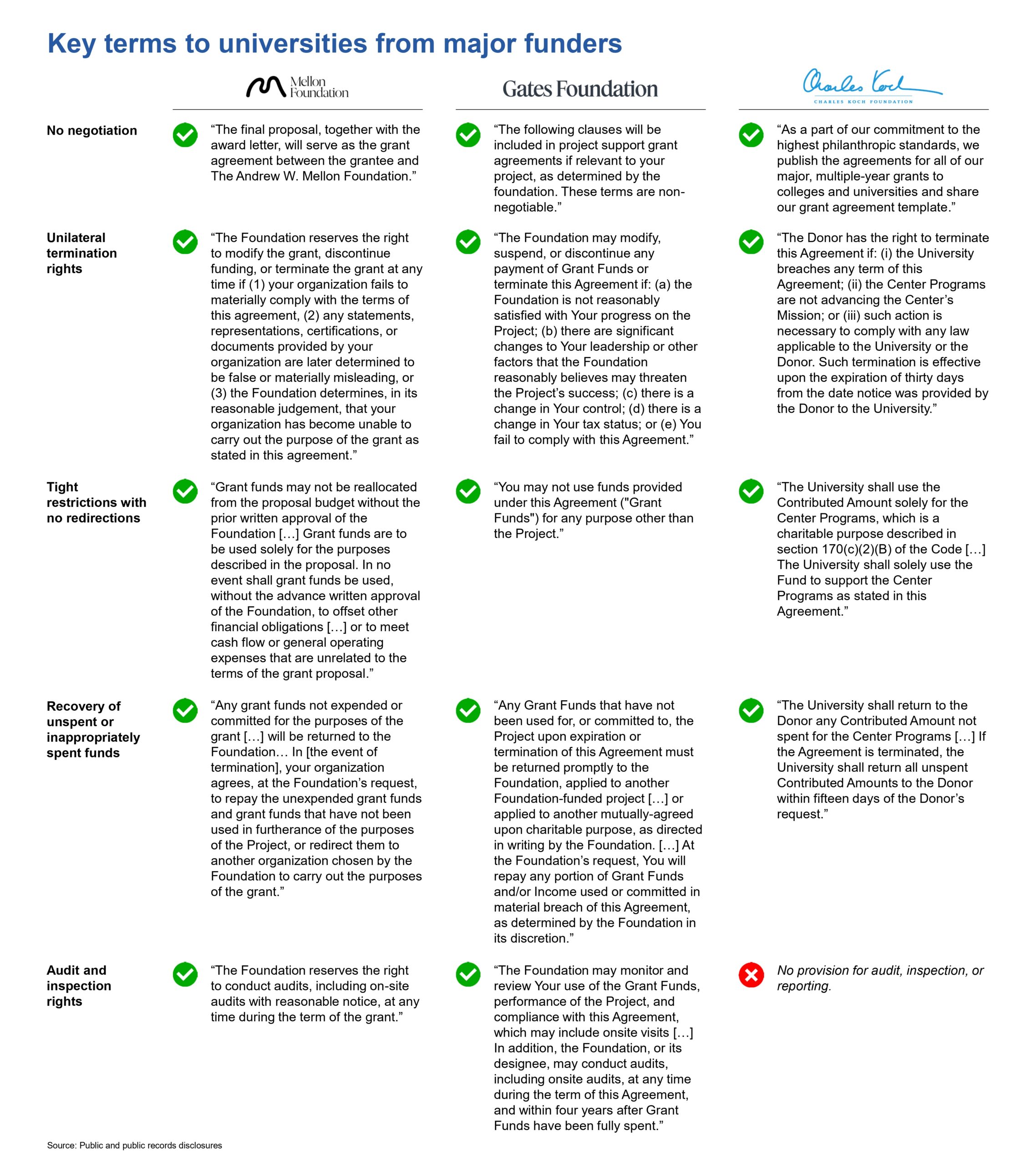
One particular quirk: as the table shows, the Koch Foundation’s terms are the loosest of the three. For example, no audit or inspection rights, limited termination rights and explicit deference to academic freedom and the university’s own hiring procedures. Yet Koch is the only one to have provoked organized, well-funded, sustained opposition such as UnKoch My Campus criticizing them for “exerting undue influence on colleges and universities nationwide.” To the best of our knowledge, nobody has organized an UnGates My Campus or an UnMellon My Campus, although both foundations enforce terms that are considerably more intrusive. Whatever explains that gap, it is not in the documents.
Mellon: a masterclass in donor leverage
A fascinating window into that machinery comes from Mellon, the most fully documented of the three thanks to the public records available. That record shows a sequence of three steps over which a university concedes every condition without a single one of them ever having been on the table.
First, Mellon makes its standing grantmaking policies, and the fact that they apply identically to every applicant, known before applicants even apply. And when they do apply, it is usually by invitation. The policies were even publicly published on their website until being taken down sometime in 2025, but are saved on the Internet Archive. These policies include the unilateral right to terminate funding, the foundation holding a veto on changes to grant activities and even the right to “conduct on- and offsite audits of records related to the use of grant funds.”
Second, the application is not accepted until the university has pre-agreed to those conditions in writing, no less than three times. Every application closes with a “Grantee Obligations Notice” and a checkbox affirming acceptance, signed before Mellon reads the proposal on its merits. The application also requires a cover letter affirming the university’s commitment to obey in advance.
Additionally, the application requires an endorsement letter from someone with authority to bind the institution such as a “chief executive officer, vice-chancellor, rector or president,” not a professor. As an example, UCLA’s 2020 application for $5 million to support development of the UCLA Mellon Social Justice Curriculum in their undergraduate college arrived with letters signed by its provost and two deans affirming their “full compliance,” in the tone a supplier might use with a customer.
Third, the award letter that follows is not a template for negotiations. Rather, the combination of the signed application and the award letter “will serve as the grant agreement.” Interestingly, this means if the grant applicant voluntarily provided politically or ideologically inflected language in the application—as Tyler Austin Harper reports Mellon representatives “tightly coached” applicants to do—then such language forms part of a legally enforceable contract.
The difference is such language is provided by the applicants (albeit with “coaching”), thereby both preserving the applicant’s sense of agency and neutralizing accusations the funder placed their proverbial thumb on the scale. The award letter also requires countersignature before any funds are disbursed.
At no point in this entire process does a “negotiation” occur, and yet Mellon achieved all of its aims. What is described here is a masterclass in exerting donor leverage, but without the outward appearance of doing so.
Two doors into the same building
So why would a university eagerly accept from Mellon in a week what it will contest with Steve for months? Routing is another answer. Universities have two distinct methods for accepting grants: sponsored research grants and gifts. A grant with budget periods, mandatory reporting and an audit trail fits the university definition of a sponsored research award, similar to a federal research grant. It goes to a research administration office whose job is compliance rather than negotiation, because nobody negotiates with the National Institutes of Health.
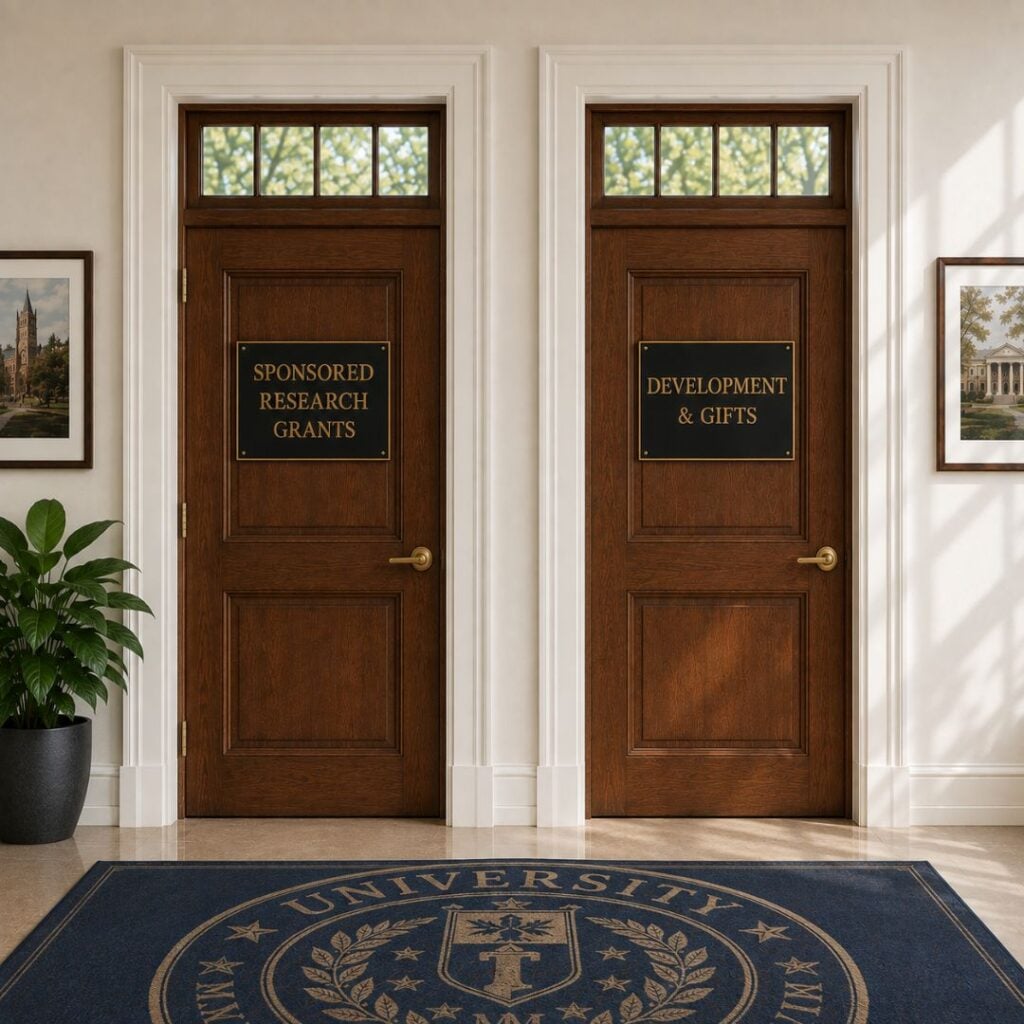
A gift of the same size, routed through the development office, lands with people whose job is donor relationships and whose professional instinct is to preserve flexibility. So when a development officer tells a donor a condition is unprecedented and unacceptable, that may be perfectly true in the world of gifts, even as the research administration office in the next building approves that exact condition several times a month without comment.
The point is not that private funders should acquire undue influence over scholarship, hiring or teaching. Academic freedom rightly abhors such influence. It is that universities already respond differently to different forms of private money, and those differences should be visible to all who have a stake in American higher education.
Either way, none of this is secret or otherwise improper. This is a high-leverage operating playbook, executed with impressive discipline by consummate professionals who are very good at their jobs. The correct first reaction should be unrestrained admiration and respect. The second reaction should be understanding what can be learned from it.
What the money is allowed to touch
This has implications in what different classes of donors can fund. My research found the largest private foundations, giving more than $100 million over the course of the 15 years covered by the data set, invest 71% of their money into the core faculty-facing academic mission: research, capital, STEM and the humanities, arts and social sciences. Only 26% went to more fungible purposes such as student financial aid and general support. The tens of thousands of small foundations, each giving under $10 million, are almost the exact inverse: 19% into the academic core, 76% into financial aid and general purposes.
This is a fundamental category difference. Financial aid changes who sits in the seats. Research money changes who stands at the front of the room, what gets studied, who leads the next generation or even whether a field has a next generation at all. Mellon’s Humanities for All Times 2025 call for concepts reached even further into core curricula, specifically saying “submissions oriented toward revising an institution’s entire general education program are especially welcome.” Large funders can quietly reshape the entire trajectory of undergraduate education. Everyone else underwrites affordability and keeping the lights on, and gets warmly thanked.
Three things to do about it
The first is to shift giving toward faculty and research, and to structure it as a sponsored award rather than a gift. Universities are quite open about the basis of routing (here are policies for Harvard, Ohio State, Georgia Tech and Kennesaw State.) Routing determines which office receives the grant, and which office receives it determines whether the terms are reviewed for compliance or contested line by line.
The second is to stop taking no from people who have already said yes to someone else. A donor does not need to match a foundation’s size to make that point, because the records are already out there. Gates and Koch publish their terms. Mellon’s grant applications are obtainable through a public records request at any public institution that has taken its money, as nearly 200 have. Put all three on the table before the conversation starts. The next time a university calls a condition impossible, the question is not whether the condition is reasonable. The question is: you already accepted this, in writing, from Gates, Mellon and Koch. Why not me?
The third follows from the other two, and it is the one a single donor cannot do alone. The leverage that makes all this work comes from repetition. A funder writing dozens of grants a year on identical terms can decline anyone who asks for an exception and lose very little by doing it. A single gift to one’s own alma mater, where there is presumably a reservoir of goodwill and emotional attachment, cannot manufacture that posture, no matter how large the check, because the donor has nowhere else to go. That is the one part of the machinery a lone donor cannot build alone, but something that behaves like a dispassionate, repeat player can.
Donors dismayed by the culture of American universities, and by who is being hired into the faculty pipeline and who is not, have spent a generation naming buildings, endowing chairs and supporting annual funds and financial aid, little of which touches faculty incentives or the pipeline. The mechanism that does touch them is not a secret. The large foundations did not invent leverage. They built the machinery, ran it consistently and wrote every step of it down. And what is legible is replicable.
Tao Tan is an affiliate at the Center for the Future of the American University at the American Enterprise Institute.
