Executive Summary
This paper examines the effects of capital gains taxation on philanthropic activity, with particular emphasis on charitable giving funded through appreciated assets and the mobility of high-income donors. Capital gains taxes directly reduce the after-tax value of investments, constraining one of the primary channels through which large charitable gifts are made. Because major donors disproportionately derive their resources from capital income—often in the form of appreciated assets—higher taxes on investment income reduce the after-tax value of appreciated assets. This in turn discourages the large, asset-based gifts that nonprofits rely on to build endowments and fund long-term investments.
Using Washington state’s 2022 capital gains tax as a case study, the paper documents sharp post-implementation declines in the residency of high-income households, net income flows, and non-cash charitable contributions to the state’s largest community foundations. The timing, magnitude, and persistence of these changes are difficult to explain by market fluctuations alone and are consistent with behavioral responses predicted by public finance theory. Non-cash donations, typically gifts of appreciated assets, fell dramatically in the first year of the tax and remained well below levels implied by equity market performance in subsequent years. This suggests a structural shift in donor behavior rather than a temporary wealth effect.
Beyond short-run giving responses, capital gains taxes also undermine philanthropy through their effects on investment, entrepreneurship, and capital formation. By discouraging risk-taking and distorting capital allocation, these taxes reduce the long-run creation of philanthropic wealth and amplify the fiscal consequences of donor migration.
Taken together, the evidence indicates higher capital gains taxes impose significant and often overlooked costs on civil society by weakening nonprofit funding, eroding donor bases, and reducing the resources available for charitable investment. Policymakers seeking to support a robust nonprofit sector should therefore avoid raising existing capital gains taxes or introducing new ones. Instead, they should prioritize policies that encourage investment, wealth creation, and sustained philanthropic engagement.
Introduction
Capital gains taxes impose significant barriers to charitable giving by reducing the after-tax value of investments, which directly limits the resources available for donations to nonprofit organizations. These taxes apply to the profit made from selling assets, such as stocks or real estate, and they directly affect the ability of donors to contribute to the nation’s 1.9 million nonprofit organizations. Generous donors who provide a significant share of philanthropic funding often rely on the proceeds from appreciated assets to make substantial contributions. When capital gains taxes are applied, the after-tax value of these assets decreases. This limits the resources available for charitable giving and constraining the impact of nonprofit organizations across the country.
The United States is already a high-tax jurisdiction for capital gains and dividends, with top marginal rates of 29.2%.1Bunn, Daniel, and Elke Asen. “Savings and Investment: The Tax Treatment of Stock and Retirement Accounts in the OECD.” The Tax Foundation, 2021. This figure includes the top Federal rate of 20%, plus state taxes, and the 3.8% Net Investment Income Tax (NIIT). This is significantly higher than both the OECD average long-term capital gains rate of 19.1% and the average dividend tax rate of 24.4%.
What’s more, capital gains taxes are applied to distributions from a company that has already paid corporate income taxes on the profit, which were 25.77% across state and federal in 2023.2Bunn and Elke, 2021 In other words, a company pays $25.77 in combined state and federal corporate taxes on every $100 of profit, then distributes its remaining $74.23 to shareholders, who are required to pay $21.70 in capital gains.
Capital gains taxes can affect philanthropy directly and indirectly. Investors, who are key drivers of charitable giving, rely on investment gains to fund their contributions. Increased taxation reduces the after-tax value of their investments, limiting their capacity to donate. Furthermore, higher taxes on capital discourage entrepreneurial activity and investment, ultimately reducing overall economic growth and subsequent charitable contributions.
Proposals to implement these taxes at the state level or expand them at the federal level further threaten to harm philanthropic activities and the broader nonprofit sector. Capital gains taxes play a critical role determining the flow of investment and charitable giving, as they influence the behavior of investors and the availability of resources for charitable purposes. This paper explores the ways higher capital gains taxes could adversely impact philanthropy, as well as how such policies undermine economic efficiency, reduce investment, and constrain the resources available for charitable endeavors.
Background and Survey of Recent Changes
Most U.S. states tax capital gains at ordinary income tax rates, while eight states apply reduced rates, and an additional eight states apply no tax to capital gains.3Loughead, Katherine. “State Tax Rates on Long-Term Capital Gains, 2024.” The Tax Foundation, 2024. However, in recent years there has been an emerging trend of states imposing additional capital gains taxes on top of ordinary income taxes, particularly aimed at high earning individuals. As of early 2026, three states have imposed such capital gains surtaxes. These states are Minnesota, Maryland, and Washington, which implemented the tax despite having no state-level ordinary income tax. 4In the case of Washington, the state has no income tax.
Minnesota has applied an additional 1% tax on net investment income exceeding $1 million since tax year 2024, while Maryland layers on an additional 2% surtax on net capital gains once federal adjusted gross income exceeds $350,000. Washington penalizes investment gains at a much lower income level and a much higher rate.
Taking effect in 2022, Washington imposes a 7% capital gains tax on long-term gains over $250,000, which includes stocks, bonds, business interests, and other investments.5“Washington enacts capital gains tax.” PricewaterhouseCoopers, June 2021. https://www.pwc.com/us/en/services/tax/library/washington-enacts-capital-gains-tax.html This is also the income threshold for the Net Investment Income Tax (for married filing jointly), making this a significant marginal tax increase. In the same year that the tax came into effect, Washington saw a net loss of high-income households, with 100 households ($200,000-plus) leaving for every eighty-eight that arrived.6Edwards, Chris. “Interstate Migration of High Earners and Retirees.” Cato Institute, 2024. https://www.cato.org/blog/interstate-migration-high-earners-retirees. A trend that is likely to get worse over time. By imposing a 7 percent tax on the capital gains of high-income earners, the state is effectively penalizing the very individuals who have the greatest means, and inclination, to make significant charitable contributions. Their philanthropy provides critical funding that many nonprofits rely on to survive and tackle society’s most pressing challenges.
While no single factor determines relocation decisions, Washington’s capital gains tax meaningfully increased the cost of large equity sales for residents at precisely the scale relevant for major philanthropic donors. This incentivizes some of the state’s wealthiest and most generous donors to leave and take their generosity with them. In 2023, Jeff Bezos, the former CEO of Amazon and the world’s second-richest individual, relocated from Washington to Florida following the implementation of a new tax. While still a Washington resident, Bezos would have owed roughly $70 million in state tax for every $1 billion of Amazon stock sold. Since moving to Florida, Bezos filed to sell up to 75 million Amazon shares in 2024 alone and has already sold roughly $13.5 billion worth of stock.7Pauley, Spencer. “Jeff Bezos to save nearly $1B in capital gains taxes by not living in Washington.” The Center Square, July 2024. https://www.thecentersquare.com/washington/article_eff63f6e-398c-11ef-9305-f7fea7841f2d.html Bezos has played a significant role in bolstering philanthropic initiatives in Washington. Notably, in 2022, the Bezos family contributed $710 million to the Fred Hutchinson Cancer Center in Seattle, marking the largest donation in the center’s history.8Beaty, Thalia. “Bezos family donates $710M to Fred Hutchinson Cancer Center.” Associated Press, October 2022. https://apnews.com/article/science-health-seattle-cancer-jeff-bezos-5cc25c4ad8004eb8bca5c99757f65aa5. While individual relocations are anecdotal, they illustrate the magnitude of incentives created when large equity sales face an additional state-level tax.
Data from 2022 alone indicates Washington’s 7% surcharge may have already led to the outmigration of high-income households and generous philanthropists, threatening the critical funding nonprofits depend on. Yet some states are proposing similar taxes on capital. New York, for instance, has introduced a proposal to tax unrealized capital gains.9“New York S165 Establishes a billionaire mark-to-market tax.” TrackBill, PolicyEngage LLC, 2025. https://trackbill.com/bill/new-york-senate-bill-165-establishes-a-billionaire-mark-to-market-tax/2583044/. This mark-to-market approach would impose significant burdens on investment and entrepreneurship, risking capital flight and economic stagnation. More recently, Virginia lawmakers introduced a bill that would impose a 3.8% net investment income tax starting in tax year 2027, effectively raising the state’s top income tax rate to 9.55% for high earners.10Legislative Information System (LIS). “HB378: Net investment income tax; imposes a tax on individuals, trusts, and estates.” https://lis.virginia.gov/bill-details/20261/HB378
While not always explicitly taxing capital, Washington isn’t the only example of a state imposing higher tax burdens on high earners that results in generous donors taking their giving elsewhere. When states adopt higher taxes on top earners, whether through income, capital gains levies, or broader increases in personal tax burdens, some of those most willing to give back to their communities choose to relocate. In doing so, they not only take their income but often redirect much of their philanthropic energy away from the places they leave behind. A series of high-profile relocations over the years underscores how tax policy can shape not just where wealthy individuals live, but where they choose to give.
One of the earliest and most vivid examples is Tom Golisano, the founder of Paychex. In 2009, Golisano publicly attributed his decision to leave New York for Florida to rising tax pressures on wealthy residents in his home state.11“Philanthropist, businessman B. Thomas Golisano celebrates three decades of charitable giving.” Naples Daily News, October 2015. https://archive.naplesnews.com/news/local/philanthropist-businessman-b-thomas-golisano-celebrates-three-decades-of-charitable-giving-ep-132424-337651751.html After establishing residency in Florida, Golisano became an increasingly prominent donor there, directing substantial gifts to a range of organizations across southwest Florida. Golisano announced last year that he is giving away $85 million to 41 nonprofits across southwest Florida. The gifts ranged from $150,000 to $10 million in size.12Spectrum News Staff. “Tom Golisano to donate $85 million to 41 Florida nonprofits.” Spectrum News 1, November 2024. https://spectrumlocalnews.com/nys/rochester/news/2024/11/19/tom-golisano-to-donate–85-million-to-41-florida-nonprofits His relocation illustrates how changes in tax policy can prompt high-net-worth individuals to shift both residence and philanthropic focus, bolstering civic and charitable life in their new states even as their former home communities lose out.
Similarly, Kenneth C. Griffin, founder of Citadel, left Illinois for Florida amid a backdrop of intense debates in his home state over taxes on top earners and an overall high-tax environment. Griffin’s move included relocating key operations and has been widely covered not just as a corporate shift but as creating a tangible “philanthropic hole” in Chicago.13Dupré, Brandon. “While Ken Griffin drops big bucks on Florida, Chicago left with philanthropic hole.” Crain Currency, April 2024. https://www.craincurrency.com/philanthropy/while-ken-griffin-drops-big-bucks-florida-chicago-left-philanthropic-hole
Griffin has since concentrated much of his giving in Florida, a pattern that highlights how the migration of wealthy individuals can drain local nonprofit ecosystems of major gifts and strategic capital. Professor of philanthropic studies at Indiana University’s Lilly Family School of Philanthropy Michael Moody noted: “When a donor of [Griffin’s] scale leaves, there is no doubt a big hole that is created by their absence… both in terms of money and leadership.”
The trend extends beyond traditional residency moves to include the geographic affiliation of charitable vehicles. Larry Page, co-founder of Google, responded to California’s proposed Billionaire Tax Act by relocating numerous business entities out of the state. Crucially for this analysis, Page’s philanthropic apparatus, including his wife’s Oceankind grantmaking LLC and the Carl Victor Page Memorial Foundation, which distributed over $285 million in grants in 2024, also moved its reporting address out of California.14Langley, Hugh. “Larry Page is officially moving business out of California ahead of a proposed billionaire’s tax.” Business Insider, January 2026. https://www.businessinsider.com/larry-page-leave-california-wealth-billionaire-tax-koop-google-2026-1 This shift foreshadows a significant redirection of grantmaking away from the communities that once anchored the Page family’s giving.
Another compelling case is Fisher Investments. After the Washington Supreme Court upheld the state’s capital gains tax, Ken Fisher announced the firm would relocate its headquarters from Washington to Texas. The Fishers have long been active donors, particularly in areas of environmental and ecological research and conservation. Their departure, prompted in part by tax policy, illustrates how higher state taxes can trigger not just personal and corporate relocations, but the concomitant relocation of philanthropic engagement.
What these examples share is not merely the physical movement of wealthy individuals but the reallocation of their philanthropic capital. For communities across the United States, the departure of major donors represents not just a symbolic loss but a tangible shortfall in charitable contributions that support education, health care, conservation, and cultural institutions. Tax policy, in these instances, operates as more than a fiscal instrument; it becomes a determinant of where generosity flows.
In aggregate, these cases challenge the assumption that high-tax states can levy increased burdens on top earners without collateral effects on civic life. When generous donors choose new homes with more favorable tax climates, they often take with them the giving behaviors that enriched their original communities.
The loss of philanthropic capital through tax-induced migration is only one channel through which higher taxes on capital harm civil society. Even when donors remain in place, capital gains taxes weaken the very processes—investment, entrepreneurship, and capital formation—that generate philanthropic wealth in the first place. In this sense, the erosion of giving documented above is not an isolated outcome, but part of a broader pattern in which higher taxes on capital reduce both the supply of wealth and the capacity for generosity.
Literature on Taxation and Philanthropy
At the center of the empirical literature on taxation and philanthropy is the concept of the tax price elasticity of charitable giving. The tax price of giving reflects the after-tax cost of a charitable contribution and is primarily determined by marginal tax rates and the availability of deductions or credits. The tax price elasticity measures the responsiveness of charitable donations to changes in this cost, providing an estimate of how donors adjust their giving when tax incentives change. As such, it has become a central parameter in public finance analyses of charitable tax policy.
A large body of empirical work finds charitable giving is sensitive to tax incentives. Deductions for charitable contributions lower the effective price of giving by allowing donors to subtract the value of their contributions from taxable income, thereby increasing the after-tax return to donating. A comprehensive literature review and meta-analysis of more than fifty studies finds that a 1% increase in the tax benefit associated with charitable giving leads to a statistically significant increase in donations of approximately 1.3 percent.15Salmon, Jack. “How Tax Policy Affects Charitable Giving.” Philanthropy Roundtable Research Paper, June 2024.
Put differently, a one-dollar increase in the tax benefit is associated with roughly $1.30 in additional charitable contributions. These findings are often interpreted as evidence (e.g., Andreoni 2006) that higher marginal tax rates, by increasing the value of deductions, may stimulate charitable giving.16Andreoni, James. “Philanthropy,” Handbook on the Economics of Giving, Reciprocity and Altruism, in: S. Kolm & Jean Mercier Ythier (ed.), Handbook of the Economics of Giving, Altruism and Reciprocity, edition 1, volume 1 (2006).
In this vein, some researchers have said that the deductibility of charitable donations makes taxes on capital gains less costly, and therefore could have little or even positive effects on donative behavior.17Bakija, Jon, and Bradley T. Heim. “How Does Charitable Giving Respond to Incentives and Income? New Estimates from Panel Data.” National Tax Journal 64, no. 2.2 (2011), 615-650; Cordes, Joseph J. “Re-Thinking the Deduction for Charitable Contributions: Evaluating the Effects of Deficit-Reduction Proposals.” National Tax Journal 64, no. 4 (2011), 1001-1024. Following on this string of research, economists have said tax cuts, such as the Tax Cuts and Jobs Act (TCJA) in 2017, led to a decrease in charitable giving by raising the value of the standard deduction.18Han, Xiao, Daniel Hungerman, and Mark Ottoni-Wilhelm. “Tax Incentives for Charitable Giving: New Findings from the TCJA.” National Bureau of Economic Research, no. 32737 (2024).
However, interpreting tax price elasticity estimates as evidence that higher taxes are beneficial for philanthropy is conceptually incomplete. The tax price elasticity captures substitution effects driven by changes in the relative cost of giving, not the overall impact of higher taxes on philanthropic capacity.
In particular, this literature abstracts from the income effects of taxation, which operate in the opposite direction. Higher taxes reduce after-tax income and wealth, thereby constraining the resources available for charitable giving. As a result, the net effect of tax increases on philanthropy depends not only on the tax price elasticity, but also on the income elasticity of giving.
The income elasticity of charitable giving measures the responsiveness of donations to changes in income. A substantial body of research finds that charitable giving rises with income, with most estimates of the income elasticity falling between 0.4 and 0.9,19(Clotfelter, 1985; Auten et al., 2002; Bakija and Heim, 2008) and clustering around 0.7.20See Salmon (2024) for full list of studies.
This implies a 10% increase (or decrease) in income is associated with an approximately 7% increase (or decrease) in charitable giving. Consequently, policies that raise tax burdens and reduce after-tax income are likely to exert downward pressure on charitable contributions through this channel, even if they increase the tax incentive to give.
An additional limitation in much of the empirical literature on tax incentives and charitable giving is its heavy reliance on federal income tax return data. Because most studies measure charitable contributions using itemized deductions reported on federal returns, they implicitly restrict attention to a subset of donors and tax incentives. This approach overlooks the behavior of non-itemizing donors but also overlooks the fact that charitable giving incentives operate at the state level too.
As of recent years, thirty-one states offer deductions for charitable contributions, meaning many donors face meaningful tax incentives to give even if they do not itemize at the federal level. Analyses that exclude state-level deductibility therefore risk mismeasuring both the tax price of giving and the total amount of charitable contributions.
This omission can materially affect empirical conclusions. When state charitable deductions are incorporated into the analysis, the apparent declines in giving associated with changes in federal tax policy are substantially attenuated or disappear altogether. McClelland (2022), for example, shows that once state-level deductibility is accounted for, reductions in charitable giving following federal tax changes are far smaller than suggested by studies relying solely on federal itemized returns.21McClelland, Robert. “Using State-Level Data To Understand How the Tax Cuts and Jobs Act Affected Charitable Contributions.” Urban Institute, October 2022.
These findings suggest donors may reoptimize across tax jurisdictions and reporting margins, rather than reducing their underlying generosity. More broadly, they underscore that estimates derived from federal tax data alone may conflate changes in reporting behavior with changes in actual giving. This reinforces the need for caution when interpreting tax price elasticity estimates as evidence about the aggregate effects of tax policy on philanthropy.
A related body of research examines how capital gains taxation affects the realization of appreciated assets. While this literature does not focus explicitly on charitable giving, its findings have direct implications for philanthropy, given the central role that appreciated assets play in financing large charitable gifts.
Dowd, McClelland, and Muthitacharoen (2012) estimate that a permanent 10 percent increase in capital gains tax rates reduces realizations by approximately 7 percent.22Dowd, Timothy, Robert McClelland, and Athiphat Muthitacharoen. “New Evidence on the Tax Elasticity of Capital Gains.” Joint Committee on Taxation; Congressional Budget Office, 2012. Using a panel of individual taxpayers over a ten-year period, the authors model realizations as a function of past, current, and expected future tax rates. This allows them to distinguish between short-run timing responses and longer-run behavioral effects. Their results indicate a substantial and persistent reduction in realizations following tax increases, even after accounting for intertemporal shifting—the tendency of taxpayers to shift realizations across tax years in response to anticipated rate changes.
Using a different dataset and empirical strategy, Dowd and McClelland (2019) reach similar conclusions, estimating that a 10% increase in capital gains tax rates reduces realizations by roughly 8%.23Dowd, Timothy, and Robert McClelland. “The Bunching of Capital Gains Realizations.” National Tax Journal 72, no. 2 (2019). More recently, Dowd and McClelland (2024), using individual-level federal tax return data, found a short-run elasticity of realizations of approximately −1.2 within the current tax year and a longer-run elasticity of −0.7 in subsequent years.24Dowd, Timothy, and Robert McClelland. “Capital Gains to Lagged Tax Rates and Migration.” Tax Policy Center, 2025. Together, these studies imply “permanent” realization elasticities in the range of −0.7 to −0.8. This is consistent with the elasticity of realizations estimates used by the Joint Tax Committee and Office of Tax Analysis.25Joint Committee on Taxation and Congressional Budget Office. “New Evidence on the Tax Elasticity of Capital Gains.” Joint Working Paper. JCX-56-12 CBO Working Paper 2012-09 (2012).
These findings are highly relevant for charitable giving. Most large charitable contributions are funded through appreciated assets such as publicly traded stock, real estate, and business interests. If higher capital gains taxes substantially reduce realizations, they may also affect charitable giving through offsetting channels. On one hand, higher tax rates increase the advantage of donating appreciated assets rather than selling them, since the embedded gain escapes taxation. On the other hand, higher rates encourage longer holding periods and reduce portfolio turnover, which can dampen the reallocation of assets into charitable gifts and limit the supply of assets donors are willing to part with.
As a result, even in the absence of an explicit change in charitable tax incentives, increases in capital gains taxation may affect asset-based giving through offsetting channels. While higher rates increase the tax advantage of donating appreciated assets, they also reduce realizations and portfolio turnover. This can dampen the reallocation of assets into charitable gifts, particularly to the extent that large donations are tied to liquidity events and portfolio rebalancing.
Literature on Capital Gains Taxation and Economic Dynamism
Beyond these static considerations, higher taxes on capital introduce dynamic effects that are typically absent from reduced form estimates of tax price elasticity. Taxes on capital gains affect investment, entrepreneurship, capital accumulation, innovation, and long-run productivity growth.
To the extent that charitable giving tends to remain a relatively stable share of aggregate income, roughly 2% of national income over several decades, policies that reduce the level or growth rate of income and wealth will, over time, reduce the absolute level of philanthropic resources available to nonprofit organizations. These general equilibrium effects are particularly salient for large gifts funded by appreciated assets, which depend on both capital formation and realized investment returns.
These dynamic effects are especially relevant for planned giving vehicles, which serve as a key institutional link between capital formation and long-term philanthropy. Donor-advised funds (DAFs) allow individuals to contribute appreciated assets, avoid capital gains taxation, and distribute charitable grants over time, making them a major source of flexible and durable philanthropic capital. Collectively, DAFs hold approximately $326 billion in assets and distribute roughly $65 billion annually to nonprofit organizations, underscoring their importance within the broader charitable ecosystem.26DAF Research Collaborative. “The Annual DAF Report 2025.” National Philanthropic Trust, December 2025. https://www.nptrust.org/reports/daf-report/
Higher capital gains taxes may affect these vehicles through two distinct channels. First, they alter the incentives to contribute appreciated assets. While higher tax rates increase the value of avoiding capital gains through donation, they also reduce realizations and portfolio turnover, potentially limiting the flow of assets into DAFs and similar structures.
Second, higher capital gains taxes reduce the after-tax return to saving and investment, which can slow wealth accumulation over time. To the extent that DAF contributions and other forms of planned giving are funded out of long-term capital growth, this channel reduces the overall pool of resources available for philanthropic use.
Even if current giving does not immediately decline, these effects can discourage the accumulation of philanthropic capital within DAFs and other planned giving structures, leading to less predictable and less stable funding streams for nonprofit organizations over time. In this way, capital gains taxation affects philanthropy through contemporaneous giving decisions, and by eroding the institutional mechanisms that translate long-run wealth creation into sustained charitable support.
For decades economists have illustrated the distortive effects of taxes on capital income, an integral component of philanthropic generosity. As early as the 1980s, Poterba and Summers (1984) found that “dividend taxes reduce corporate investment and exacerbate distortions in the intersectoral and intertemporal allocation of capital.”27Poterba, James, and Lawrence Summers. “The Economic Effects of Dividend Taxation.” National Bureau of Economic Research, no. 1353 (1984). Higher taxes create inefficiencies in capital markets, preventing resources from flowing to their most productive uses. Such inefficiencies lead to slower economic growth, reducing the capacity for charitable giving. Becker et al. (2013) reinforce this point, noting payout taxes “lock in” investments within profitable firms, limiting the reallocation of capital to emerging enterprises.28Becker, Bo, Marcus Jacob, and Martin Jacob. “Payout taxes and the allocation of investment.” Journal of Financial Economics 107, no. 1 (2013), 1-24.
High capital gains taxes also discourage entrepreneurship. In the 1990s, Federal Reserve Chairman Alan Greenspan said capital gains taxes “impede entrepreneurial activity and capital formation,” which are critical for wealth creation and philanthropy.29Comments by Federal Reserve Chairman Alan Greenspan in testimony before the U.S. Senate Banking Committee on February 25, 1997 Stifling innovation reduces the potential for transformative charitable contributions that address societal challenges. Gentry (2016) demonstrates that “higher capital gains tax rates are associated with a reduction in state-level disbursements from venture capital funds.”30Gentry, William M. “Capital Gains Taxation and Entrepreneurship.” Williams College, March 2016.
States with higher rates see fewer new businesses seeking venture funding, directly affecting the pipeline of wealth creation and, subsequently, philanthropic giving. Edwards and Todtenhaupt (2020) find reductions in capital gains taxes “increase investment in start-up firms by about 12%.”31Edwards, Alexander, and Maximilian Todtenhaupt. “Capital gains taxation and funding for start-ups.” Journal of Financial Economics 138, no. 2 (2020), 549-571. Recent empirical studies similarly find increases in capital gains taxation lead to incrementally lower innovation exchanges between start-ups, while firms decrease the level of investment in start-ups (Dimitrova and Eswar, 2022).32Dimitrova, Lora, and Sapnoti K. Eswar. “Capital Gains Tax, Venture Capital, and Innovation in Start-Ups.” Review of Finance 27, no. 4 (2022), 1471-1519. These investments are vital for the development of new wealth and economic growth, which serve as the foundation for robust philanthropic activity.
Through these channels, capital gains taxes reduce productivity and economic growth. In the late 1990’s the Joint Economic Committee published a report on capital gains taxation which concluded “a capital gains tax reduction would lower the cost of capital, boost investment, and stimulate economic growth.” Conversely, higher taxes inhibit these dynamics. Jacob (2021) says dividend taxes constrain firms’ ability to invest efficiently, leading to suboptimal use of capital and labor.33Jacob, Martin. “Dividend taxes, employment, and firm productivity.” Journal of Corporate Finance 69 (2021), 102040.
Lower taxes, on the other hand, “can result in higher productivity,” which expands the economic base and increases potential charitable contributions. Gourio and Miao (2010) further say reducing dividend taxes increases aggregate productivity by improving capital allocation across firms, with long-term benefits including a 4% increase in the capital stock.34Gourio, François, and Jianjun Miao. “Firm Heterogeneity and the Long-run Effects of Dividend Tax Reform.” American Economic Journal: Macroeconomics 2, no. 1 (2010), 131-168. A more dynamic and productive economy fosters greater opportunities for wealth creation, facilitating increased charitable giving.
Empirical evidence also suggests taxes on capital can reduce charitable giving by lowering the after-tax return to saving, rather than inducing households to accelerate giving to avoid future taxes. Using quasi-experimental variation in wealth tax exposure in Norway, Ring and Thoresen (2025) find that a 1% increase in the wealth tax reduces charitable giving by roughly 26%.35Ring, Marius A., and Thor O. Thoresen. “Wealth Taxation and Charitable Giving.” Review of Economics and Statistics, 2025, 1-45.
Importantly, the authors reject the notion of strong intertemporal substitution in giving, showing instead that households both consume and give less when the after-tax rate of return declines. Although this evidence comes from a wealth tax, it highlights a broader mechanism: when taxes reduce the return to accumulating and holding capital, they can diminish wealth formation and the philanthropic resources that flow from it.
Data and Methodology
This paper combines administrative tax data, nonprofit filings, and market return data to examine how Washington’s 2022 capital gains tax coincides with changes in (i) the location decisions of high-income households and their associated income flows and (ii) non-cash charitable contributions, a margin of giving closely linked to realized gains and gifts of appreciated assets. The empirical analysis is descriptive and quasi-experimental. It exploits the implementation of the tax as a policy breakpoint, testing whether outcomes shift sharply and persistently thereafter, even after controlling for contemporaneous equity market conditions.
Policy Timing
Washington enacted its capital gains tax in 2021, with the tax applying to long-term capital gains realized on or after January 1, 2022. The policy therefore creates a clear pre-period (through 2021) and post-period (2022 onward) for analyzing shifts in migration patterns and tax-sensitive forms of charitable giving.
Migration and Income Flows of High Earners
To measure changes in the residency decisions of high-income households, the analysis uses Internal Revenue Service Statistics of Income (SOI) migration data from the IRS “SOI Tax Stats—Migration Data” Gross Migration File (last updated March 20, 2026). The sample focuses on tax filers with adjusted gross income (AGI) above $200,000 and constructs annual net migration as the difference between the number of in-migrating and out-migrating returns in this income group. Because households differ substantially in earnings and asset income, the analysis also reports net income flows associated with movers, computed as the difference between the AGI of in-migrants and out-migrants within the $200,000-plus category.
This approach captures the scale of relocation and the economic significance of movers. Net counts indicate whether Washington is gaining or losing high-income residents, while net AGI flows indicate the magnitude of income, and potential giving capacity, that accompanies these moves.
Non-Cash Charitable Contributions
To examine giving behavior along a margin most directly connected to realized gains and appreciated-asset transfers, the analysis uses nonprofit tax filings to measure non-cash charitable contributions to Washington’s two largest (by revenue) community foundations. These two community foundations represent 54% of all community foundation revenues and 60% of all community foundation assets in the state. Specifically, annual non-cash contributions are taken from each organization’s IRS Form 990, Part VIII, Line 1g (contributions of noncash property). This measure captures gifts of appreciated securities and other property that are frequently used to fund major gifts and donor-advised contributions.
Donation amounts are converted to real 2018 dollars using the Consumer Price Index, allowing comparisons over time that are not confounded by inflation. The analysis focuses on the 2018–2024 period, which provides several pre-policy years and multiple post-policy years to assess persistence.
Market Returns and Controls
Because non-cash giving is plausibly correlated with asset market conditions, the analysis incorporates annual equity market returns as a control. Annual S&P 500 returns are taken from MacroTrends. These returns are used in two ways: (i) as a control variable in a pooled regression framework and (ii) as the basis for a market-implied counterfactual forecast of non-cash giving in the post-2021 period. Other macroeconomic factors may also influence giving over this period, including changes in interest rates, housing market conditions, and sector-specific labor market shocks such as technology-sector layoffs.
Regression Specification and Counterfactual Forecasting
To assess whether the post-2021 decline in non-cash contributions can be explained by equity market conditions, the paper estimates a simple panel regression pooling both foundations:
where 𝐺𝑖𝑡 is real non-cash contributions to foundation 𝑖 in year 𝑡, 𝛼𝑖 are foundation fixed effects, 𝑅𝑡 is the annual S&P 500 return, and 𝑃𝑜𝑠𝑡2022𝑡 is an indicator equal to one for years 2022–2024. The coefficient 𝛽 captures the association between market conditions and non-cash giving, while 𝛾 captures whether there is a discrete downward shift in non-cash contributions after the capital gains tax becomes effective, conditional on market returns. The error term may exhibit serial correlation and common time dependence, given persistent unobserved factors affecting giving and aggregate shocks not fully captured by equity market returns.
In addition to the regression, the paper constructs a market-based counterfactual forecast. Using pre-policy data (2015–2021), non-cash contributions are regressed on contemporaneous S&P 500 returns for each foundation, and the fitted relationship is used to generate predicted contributions for 2022–2024 based solely on observed market returns. Forecast uncertainty is summarized using confidence intervals for the conditional mean. The resulting comparison between forecast and realized giving provides a transparent test of whether post-2021 outcomes are unusually low relative to historical market sensitivity.
Interpretation and Limitations
The empirical strategy is designed to test whether observed shifts in migration and non-cash giving coincide with the implementation of Washington’s capital gains tax and persist even after accounting for market conditions. The analysis does not claim a definitive causal estimate, given the small number of annual observations, the lumpy nature of major gifts, and the possibility of contemporaneous shocks that may also affect giving and migration. Instead, the evidence is interpreted as consistent with a behavioral response to capital gains taxation along a tax-sensitive margin, particularly non-cash gifts of appreciated assets, and as suggestive of broader philanthropic consequences associated with high-earner mobility.
The COVID-19 pandemic represents an important background shock during the sample period, affecting migration patterns, asset markets, and charitable giving nationwide beginning in 2020. While pandemic-related factors may have influenced behavior in earlier years, their timing does not align with the sharp and persistent changes documented following the 2022 implementation of Washington’s capital gains tax.
Moreover, many pandemic-era dynamics, particularly elevated asset values and unusually strong giving, would tend to bias against finding a post-2021 decline in non-cash charitable contributions. The persistence of reduced non-cash giving through 2023 and 2024, despite a strong market recovery, further suggests the observed patterns are not driven solely by transitory pandemic effects.
Evidence on the Effects of Capital Gains Taxation
High-Income Household Migration and Income Flows
High-income households play a uniquely important role in Washington’s fiscal and civic ecosystem. Tax filers earning more than $200,000 not only account for a disproportionate share of state income tax bases, but they also consistently provide 80% or more of all charitable donations in Washington.36[1] Internal Revenue Service. “SOI Tax Stats – Historic table 2.” (Last updated December 4, 2025). As a result, changes in the residency decisions of these households have implications that extend far beyond personal income flows, directly affecting the financial health of nonprofit organizations and the broader civil society.
To evaluate whether Washington’s 2022 capital gains tax coincides with changes in the location decisions of this high-income group, this section examines net migration patterns of households earning more than $200,000, along with the net inflow or outflow of their income, from 2015 through 2023.37Internal Revenue Service. “SOI Tax stats – Migration data.” Gross Migration File. (Last updated March 20, 2026). Together, these measures provide insight into whether the state is gaining or losing its most economically and philanthropically significant residents, and how much income, and potential giving capacity, moves with them.
From 2015 through 2020, Washington consistently experienced positive net in-migration of high earners, with especially strong inflows between 2016 and 2018. Net migration peaked in 2017, when more than 6,200 high-income individuals relocated to the state on net. While inflows moderated in subsequent years, they remained positive through 2020, even amid pandemic-related disruptions.
This pattern changed sharply beginning in 2021 and accelerated following the implementation of the capital gains tax in 2022. In 2021, Washington recorded a net loss of more than 2,300 high-income earners. That outflow nearly tripled in 2022, when the state lost over 6,300 high-earning individuals on net—the largest negative migration figure in the series. Again in 2023, the net outflow of high earners is sharply negative at almost 5,900.
Net Migration of Washington Residents (>$200,000), 2015-2023
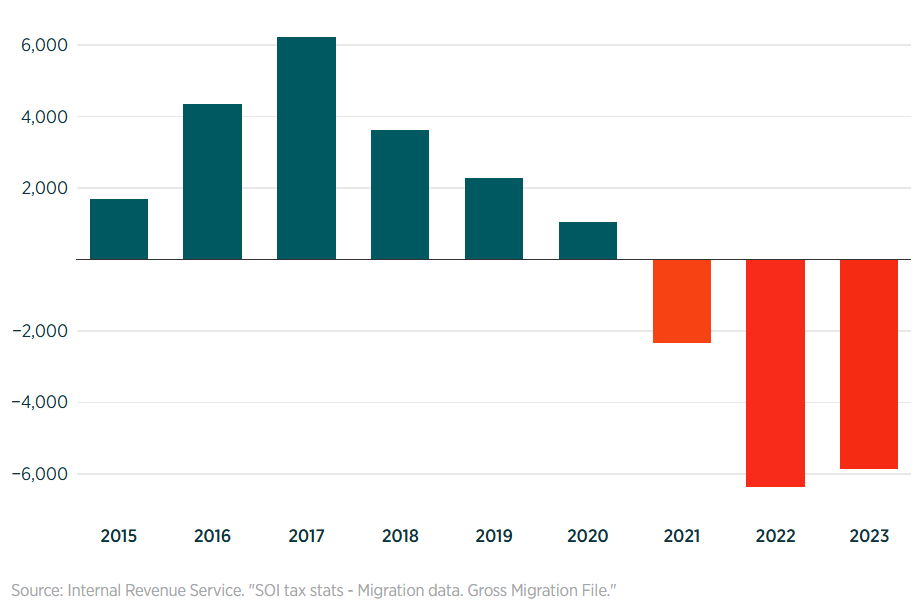
The timing of this reversal is notable. The capital gains tax was enacted in 2021 and took effect for tax year 2022, targeting long-term gains above $250,000 at a 7% rate. While migration decisions are influenced by many factors, the abrupt transition from steady inflows to historically large outflows surrounding the tax’s implementation is consistent with tax-induced relocation responses documented in the broader public finance literature. Between 2021 and 2023, the state has lost, on net, almost 15,000 high earners.
Migration counts alone understate the economic significance of these movements. High-income earners differ widely in earnings and asset holdings, meaning the income associated with movers is often more consequential than the number of movers themselves. The data on net income flow underscores this point.
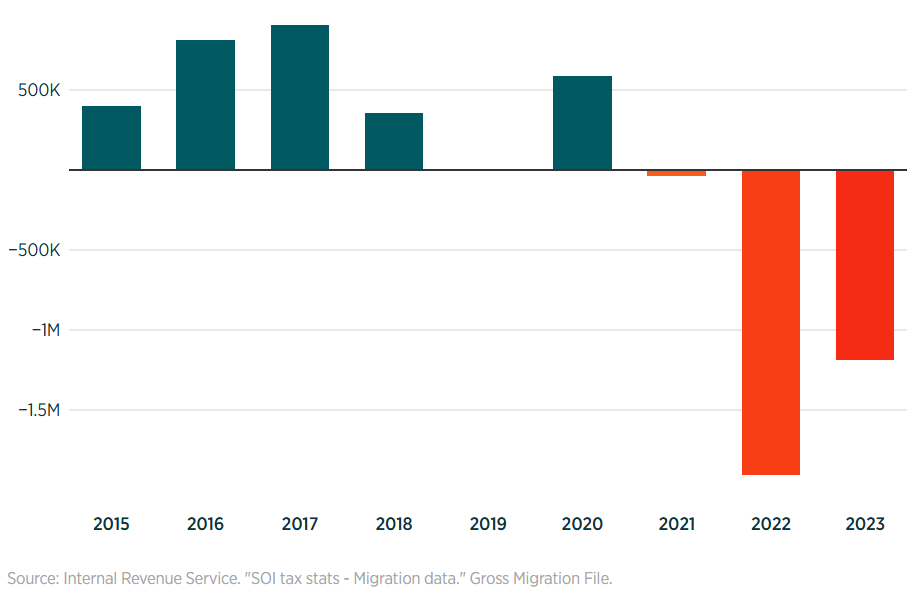
Between 2015 and 2020, Washington generally benefited from positive net inflows of high-income earnings, with particularly large gains in 2016 and 2017. Even during years with modest net migration, income inflows remained positive, reflecting the arrival of especially high-earning households.
That pattern reversed decisively after 2020. In 2021, Washington experienced a net income outflow of roughly $35 million among households earning more than $200,000. In 2022, the first year the capital gains tax applied, the net income outflow surged to more than $1.9 billion. Again in 2023, the outflow of net income remained in significant negative territory, with $1.2 billion leaving the state on net. This represents not only a loss of taxable income, but a substantial erosion of the economic base from which charitable giving is disproportionately drawn.
Net Flow of Income Among High Earners in Washington, 2015-2023
Inflow/outflow is in thousands of U.S. dollars
Given that households in this income bracket consistently provide the vast majority of charitable donations, the scale of this income loss has direct implications for Washington’s nonprofit sector. Even modest reductions in the number or income of top donors can translate into outsized declines in funding for hospitals, universities, cultural institutions, and social service organizations that rely on large gifts and capital-funded donations.
The sharp deterioration in net migration and net income flows following the introduction of Washington’s capital gains tax suggests the policy may be weakening the state’s philanthropic foundation. When high earners relocate, they do not merely take their labor income or investment returns with them; they often shift their charitable giving, board service, and philanthropic leadership to their new states of residence.
Because capital gains taxes directly target the realization of appreciated assets, the assets frequently used to fund large charitable gifts, the policy compounds its effect on generosity. It both incentivizes relocation and reduces the after-tax resources available for donations among those who remain. In this sense, the observed outmigration of high earners represents a double hit to the nonprofit sector: fewer donors and diminished giving capacity.
Non-Cash Charitable Contributions and Tax-Sensitive Giving
This section examines whether the introduction of Washington state’s capital gains tax in 2022 is associated with a change in charitable giving behavior along margins most directly affected by capital gains taxation. Rather than focusing on aggregate charitable giving, which may mask shifts between cash and non-cash contributions, the analysis centers on non-cash charitable contributions to Washington’s largest community foundations. These contributions typically consist of gifts of appreciated financial assets and therefore represent a theoretically salient margin of response to capital gains taxation.
The economic intuition is straightforward. Donating appreciated assets allows taxpayers to avoid realizing capital gains while still receiving a charitable deduction, and this treatment generally applies under federal and state tax systems. The introduction of a state-level capital gains tax therefore does not directly tax donated assets, but it does increase the cost of selling appreciated assets. As a result, it may alter the relative attractiveness of donating versus holding or liquidating assets, and induce donors to change the timing, form, or location of their charitable giving.
Importantly, such behavioral adjustments need not result in a collapse of total charitable giving. Instead, they may show up as changes in the form, timing, or location of donations. For example, if higher capital gains taxes reduce realizations or discourage donors from parting with appreciated assets, non-cash giving may decline even if overall charitable intent remains unchanged.
In that case, donors may substitute toward cash donations, shift contributions to donor-advised funds or institutions outside the taxing jurisdiction, or defer giving to future periods. For this reason, non-cash charitable contributions provide a more targeted indicator of behavioral response than aggregate giving totals.
The analysis examines annual non-cash contributions reported by Washington’s largest community foundations and evaluates whether contributions shift discontinuously after the tax becomes effective. Data construction, inflation adjustment, and variable definitions are described in the Data and Methodology section.
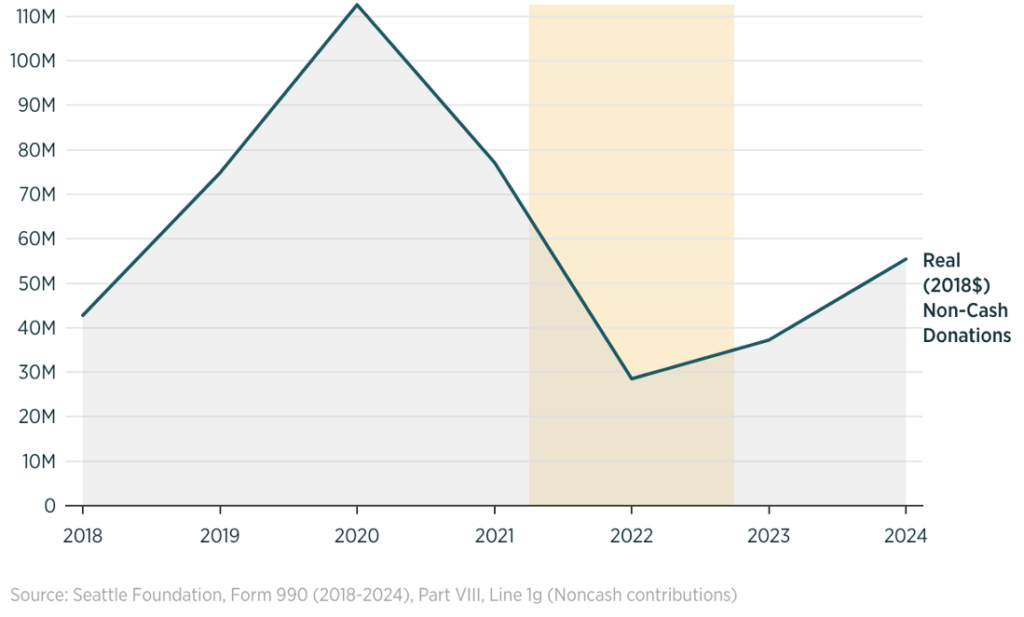
The figure below plots real non-cash donations to the Seattle Foundation, the state’s largest community foundation, over the sample period, with the orange highlighted area marking 2022, the first year of the tax. After rising substantially between 2018 and 2020 and moderating in 2021, non-cash donations fall sharply in 2022, declining by approximately 63% in real terms relative to 2021. While donations partially recover in subsequent years, they remain well below their pre-2022 real levels through 2024.
Real Non-cash Donations to Seattle Foundation, 2018-2024
Non-cash contributions in 2018 Dollars
The next figure below presents the same series for the Community Foundation for Southwest Washington. Although this foundation exhibits substantially greater year-to-year volatility, consistent with a smaller donor base and greater reliance on large individual gifts, the timing of the decline is strikingly similar. Real non-cash donations collapse in 2022, falling by nearly 90% relative to 2021. As with the Seattle Foundation, subsequent recovery is incomplete, with real donation levels remaining only slightly higher than 2018 levels six years prior.
Real Non-cash Donations to Community Foundation for Southwest Washington, 2018-2024
Non-cash contributions in 2018 Dollars
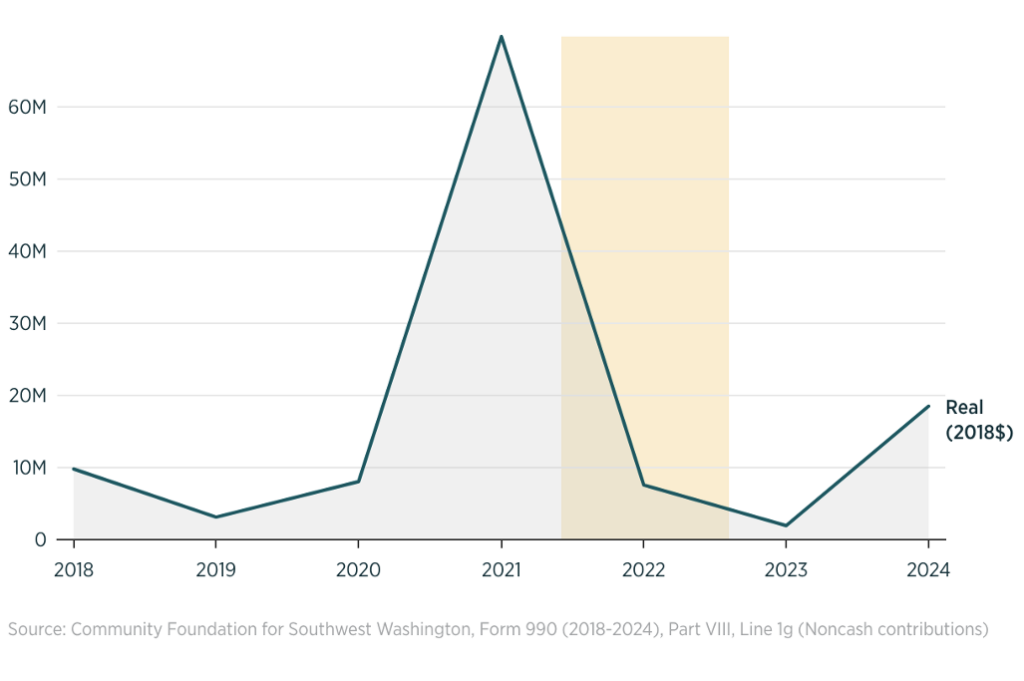
The fact that two independent institutions, serving different geographic areas and donor bases, exhibit large and discrete declines in non-cash giving in the first year of the capital gains tax is difficult to reconcile with purely idiosyncratic explanations. The synchronization of the break in 2022 suggests a common shock affecting tax-sensitive giving behavior.
A natural alternative explanation is stock-market performance. Because non-cash donations often consist of appreciated assets, they are likely correlated with equity market returns. The year 2022 coincided with a substantial market downturn, raising the possibility that the observed decline reflects a wealth effect rather than a tax response.
To assess this explanation, the following figure overlays combined (aggregated) real non-cash donations for both foundations with annual S&P 500 returns. While non-cash giving does appear to co-move with equity markets in some periods, several features of the data suggest market fluctuations alone are insufficient to explain the observed pattern.
First, earlier negative or weak market years, such as 2018, are not associated with declines of comparable magnitude. Second, and more importantly, equity markets rebound strongly in 2023 and 2024, posting returns exceeding 20% in both years, yet non-cash donations recover only partially and remain structurally below their pre-2022 levels. This persistence is inconsistent with a purely cyclical market-driven story.
Real Non-cash Donations and Market Returns (%), 2018-2024
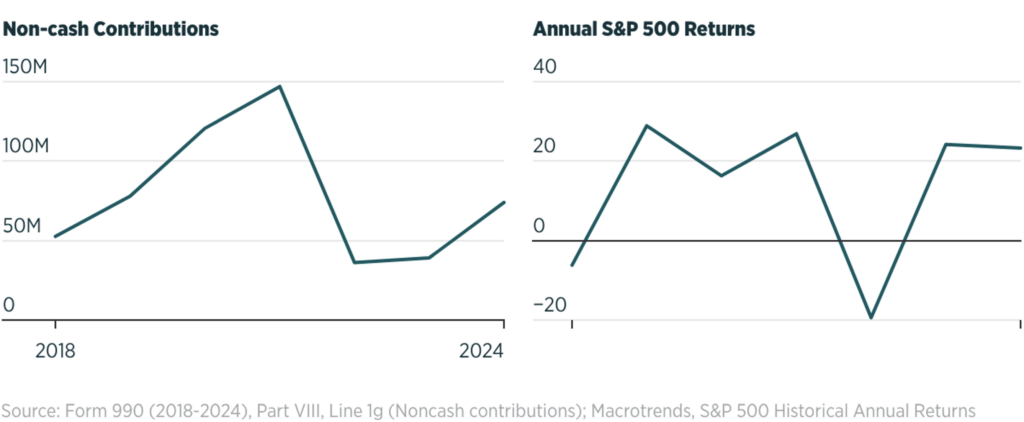
To assess whether the post-2021 decline can be accounted for by market conditions, I estimate a simple two-foundation panel specification relating real non-cash contributions to annual S&P 500 returns and a post-2022 indicator (see Data and Methodology). Consistent with a wealth-based channel, the estimated association with market returns is positive, but the post-2022 indicator remains large and negative. This indicates a discrete downward shift in non-cash giving that is not explained by contemporaneous equity performance.
Market-Based Counterfactual Forecasts of Non-Cash Contributions
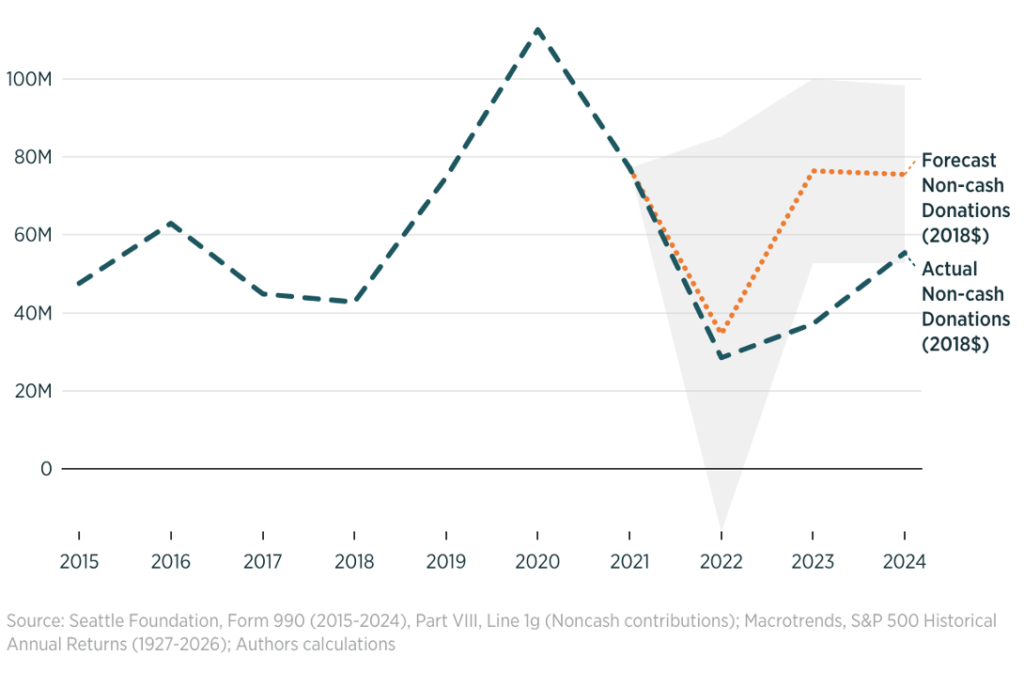
To further assess whether the post-2021 decline in non-cash charitable contributions can be explained by equity market conditions alone, this section constructs a simple counterfactual forecast based on historical market sensitivity. Using annual data from 2015 through 2021, real non-cash contributions to the Seattle Foundation and the Community Foundation for Southwest Washington are regressed on contemporaneous S&P 500 returns. This estimation window predates the implementation of Washington’s capital gains tax and spans multiple market cycles, including positive and negative return environments.
The estimated relationships are then used to forecast non-cash contributions for the 2022–2024 period based solely on observed stock market returns. These forecasts represent the level of giving that would be expected absent any structural change in donor behavior beyond that implied by market performance. Forecast uncertainty is quantified using confidence intervals for the conditional mean (gray shaded area).
Actual vs Forecast Non-cash Donations for Seattle Foundation, 2015-2024
Actual vs Forecast Non-cash Donations for Community Foundation for SW Washington, 2015-2024
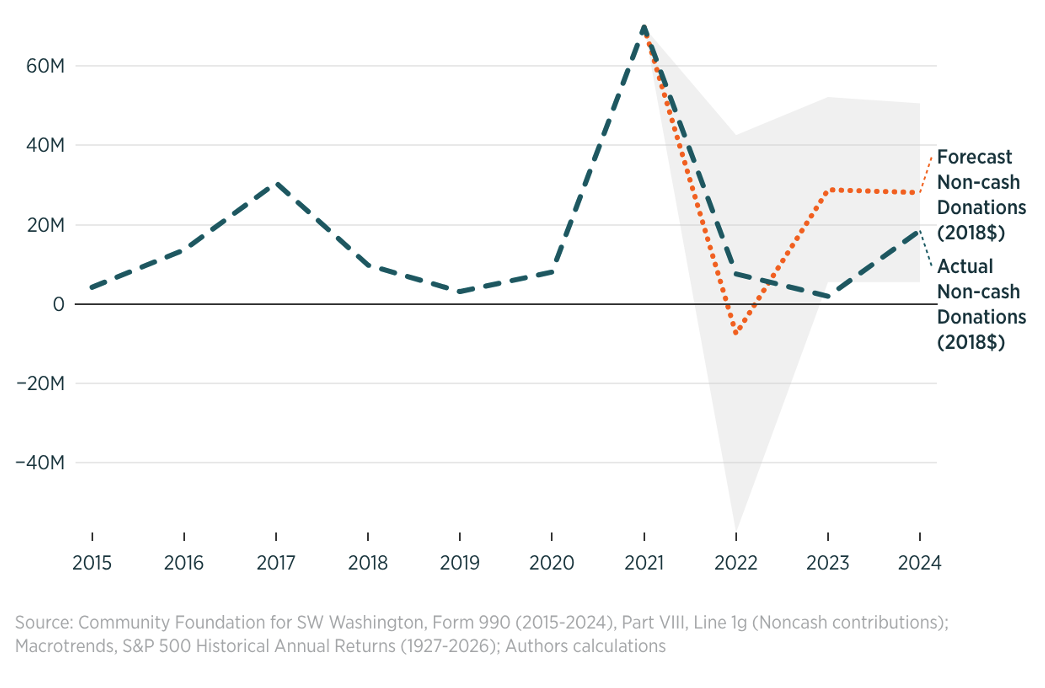
The results indicate a substantial and persistent divergence between market-implied contributions and actual outcomes following the introduction of the capital gains tax. Using central estimates, non-cash contributions to the Seattle Foundation during 2022–2024 are approximately 35% lower than predicted by market returns. For the Community Foundation for Southwest Washington, the shortfall is larger, at approximately 43% relative to forecasted levels. When the two institutions are combined, aggregate non-cash contributions during the post-2021 period are roughly 37% lower than what historical market sensitivity would predict.
Importantly, these shortfalls are not confined to the market downturn of 2022. Equity returns rebound strongly in 2023 and 2024, exceeding 20% in each year, yet non-cash contributions remain well below forecast levels. In several cases, observed contributions fall at or below (in 2023) the lower bound of the confidence intervals implied by the pre-2022 relationship between market returns and giving. This pattern indicates the divergence cannot be attributed solely to transitory market volatility or delayed wealth effects.
The persistence of this gap is particularly informative. Under a purely market-driven explanation, non-cash giving would be expected to recover in tandem with asset prices, as it did following earlier downturns such as 2018. Instead, the post-2021 period is characterized by a downward shift in the level of non-cash contributions relative to historical benchmarks, consistent with a change in the incentives governing appreciated asset giving.
The key implication of this result is not that stock-market fluctuations are irrelevant, but that they do not account for the magnitude, timing, or persistence of the observed decline. Even after accounting for market conditions, non-cash charitable giving to Washington’s largest community foundations appears to have shifted downward beginning in 2022 relative to pre-policy trends.
Discussion: Composition Effects and Asset-Based Giving
Taken together, these findings provide evidence consistent with a behavioral response to the introduction of Washington’s capital gains tax along the margin most directly affected by the policy. While aggregate charitable giving may remain relatively stable, the composition of giving changes sharply, with substantial reductions in non-cash donations of appreciated assets. This pattern aligns closely with standard public-finance predictions and underscores the importance of examining tax-sensitive margins rather than relying solely on aggregate totals.
The sharp and persistent decline in non-cash charitable contributions following the introduction of Washington’s capital gains tax is particularly consequential because gifts of appreciated assets play a central role in financing large-scale philanthropy. Major donors frequently fund substantial charitable gifts through the contribution or liquidation of appreciated stocks, business interests, and real estate. By increasing the tax burden associated with realizing these gains, capital gains taxes directly reduce the after-tax resources available for donation and weaken incentives to deploy appreciated assets for charitable purposes.
Evidence from donor-advised funds underscores the importance of this channel. According to Fidelity Charitable’s 2025 Giving Report, since its inception the organization has converted more than $15.5 billion in non-publicly traded assets into charitable vehicles, while an additional $30 billion has been generated through tax-free investment growth within those vehicles.38Fidelity Charitable. “2025 GIVING REPORT: A year of resilience, innovation, and impact in philanthropy.” Fidelity Charitable. https://www.fidelitycharitable.org/insights/2025-giving-report.html In total, more than $45 billion in charitable resources has been made available through this mechanism alone. The scale of this activity reflects the central role tax-neutral contributions of appreciated assets play facilitating major gifts and sustaining long-term charitable capacity.
Reductions in non-cash giving therefore represent more than a temporary fluctuation in donation timing; they imply a contraction in one of the most effective channels through which philanthropic capital is mobilized. Because non-cash contributions are often used to endow institutions, finance capital projects, or support long-horizon initiatives, persistent declines in this margin can materially weaken the financial foundations of nonprofit organizations even if aggregate giving appears relatively stable.
Conclusion
The rise of state-level capital gains levies and surtaxes presents a significant challenge not only to capital formation and investment, but also to the financial sustainability of nonprofit institutions that rely disproportionately on donations funded by appreciated assets. Capital gains taxes reduce the after-tax value of investments, weakening incentives to realize gains and directly constraining one of the most important channels through which large charitable gifts are made. As a result, these taxes affect philanthropy not merely in the aggregate, but along precisely the margins most relevant for major donors and nonprofit organizations.
The evidence from Washington state illustrates these dynamics clearly. Following the introduction of a 7% state capital gains tax in 2022, non-cash charitable contributions to the state’s largest community foundations declined sharply and persistently, remaining well below levels predicted by equity market performance alone.
This pattern is consistent with a behavioral response to higher capital gains taxation, in which donors reduce or reallocate gifts of appreciated assets rather than simply delaying them until market conditions improve. For nonprofit organizations, this shift represents a tangible loss of flexible, high-impact funding that is often used to finance capital projects, endowments, and long-term initiatives.
Capital gains taxation also compounds its effects through donor mobility. Washington’s experience shows higher taxes on investment income coincide with substantial outmigration of high-income households—the individuals who account for the majority of charitable giving. When these donors relocate, they do not merely take their taxable income with them; they frequently redirect their philanthropic giving, board service, and institutional leadership to new jurisdictions. The resulting erosion of philanthropic capital weakens local nonprofit ecosystems and reduces the resources available to address community needs.
Importantly, the consequences for nonprofits extend beyond immediate revenue losses. Non-cash contributions play a critical role in long-term planning and financial stability, supporting endowments, donor-advised funds, and large-scale projects that cannot be easily financed through small or recurring cash donations. Persistent reductions in this form of giving therefore undermine the ability of nonprofit organizations to invest, expand services, and respond to future challenges. Even if aggregate giving appears stable, changes in the composition of donations can materially reduce nonprofit capacity.
Taken together, the evidence suggests higher capital gains taxes impose costs on civil society that are economically and institutionally significant. By discouraging investment, incentivizing donor relocation, and reducing tax-advantaged asset-based giving, these policies weaken the financial foundations of nonprofit organizations.
A tax system that supports capital formation and preserves incentives for philanthropic investment is therefore conducive to economic growth, and essential to maintaining a vibrant and resilient nonprofit sector. Policymakers seeking to strengthen communities and support charitable institutions should carefully consider these downstream effects before expanding taxes on capital.