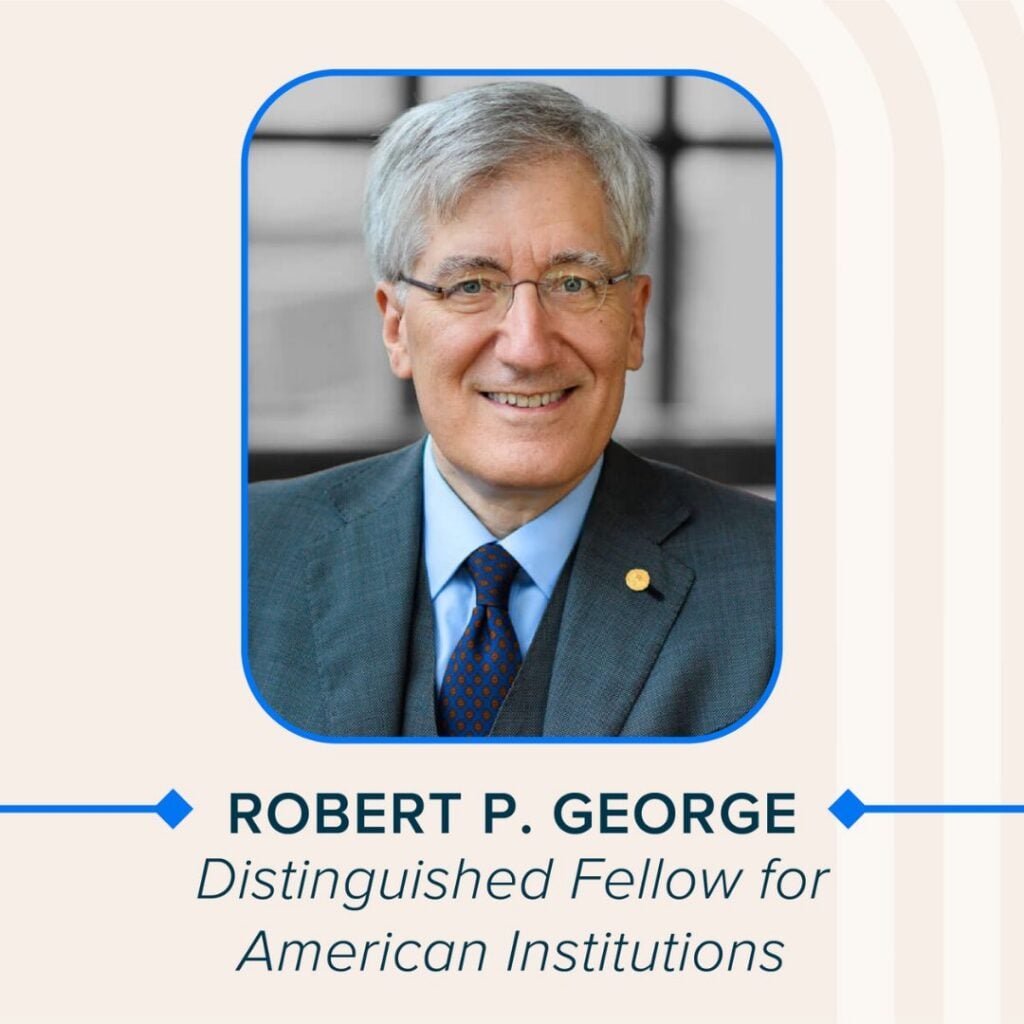
Philanthropy Roundtable’s distinguished fellow for American institutions discusses a new era of university reform, opportunities for philanthropic investment and the importance of protecting donor intent.
American higher education is at a consequential moment. New initiatives devoted to civic education, academic freedom and intellectual diversity are taking root at universities across the country, creating opportunities for philanthropists seeking to strengthen institutions central to American civic life.
Philanthropy Roundtable has long worked with donors seeking meaningful higher education reform. By connecting philanthropists with important ideas, relevant expertise and opportunities for strategic giving, the Roundtable helps them navigate institutional challenges, make informed charitable decisions and protect their donor intent.
Building on this work, the Roundtable recently welcomed Robert P. George as its distinguished fellow for American institutions. George is the McCormick professor of jurisprudence at Princeton University and founder and director of its James Madison Program in American Ideals and Institutions. A leading scholar of moral and political philosophy, he has spent decades advancing intellectual freedom, civic education and institutional reform.
Micah Sagebiel, senior vice president at Philanthropy Roundtable, met with George to explore promising developments in higher education, where targeted philanthropic investment can make a real difference, the qualities reform-minded leaders need, and why honoring donors’ charitable intentions remains essential.
Editor’s note: This written Q&A has been edited for length.
Sagebiel: Are we at a genuine turning point for academic freedom and open inquiry in higher education – or is it too early to say? What should donors be watching?
George: In fact, I think we are at a turning point. I did not expect to see this in my lifetime, though it is something I’ve been working for over the course of my entire career in academic life. The rise of the “civics movement” is an extraordinary and profoundly encouraging development. Outstanding institutes, centers and schools of civic and cultural education have been established, and are being established, at important universities—public and private—all over the country.
[…] Genuine reform and renewal are happening. From Arizona State to the University of Texas and the University of Florida, and from Johns Hopkins to Princeton, Stanford and Harvard, exciting initiatives are up and running and finding a huge market among our students. A lot of people had been tempted to give up on our colleges and universities; some people did give up. But now, here we are, entering what is quite clearly an era of reform. Of course, the key thing is not to blow it!
Sagebiel: The James Madison Program has pursued reform from within an established university, while others have invested in building new institutions. What has that experience taught you about when reform from within can succeed – and when it makes more sense to build something new?
George: Let a thousand flowers bloom! Where we can build within existing institutions, especially the most prestigious and influential colleges and universities, let’s do it. Where we are blocked—at least for now—let’s go a different route. To build within, the key thing is to find a faculty member (ideally, two or three faculty members) around whom to build. Faculty need to provide the leadership. They will need four indispensable ingredients: 1) financial resources to build the program; 2) determination to succeed, even in what might be a hostile environment; 3) courage—there is no substitute for it and 4) skill in navigating the treacherous waters of academic politics.
Sagebiel: Looking at the philanthropic landscape today, where do you think donors have underinvested – and what will be most important to strengthen the movement for the next generation?
George: A major problem today afflicting academia and the broader intellectual culture is the politicization not only of colleges and universities, but also of major para-academic institutions, such as prestigious scholarship programs, professional associations and academies and accrediting agencies. This is true, for example, of the Rhodes and Marshall Scholarship programs, the American Association of University Professors and the American Academy of Arts & Sciences and National Academy of Sciences. Historically, these institutions—which are very influential and play massive credentialing roles in academic life—were politically and ideologically nonpartisan. No more. So, we need to build competing institutions—ones that are genuinely merit-based and nonpartisan.
The visionary philanthropists John and Daria Barry have shown how to do this with their scholarship program which, effectively, competes with the Rhodes and Marshall Programs, sending top American graduates to Oxford for two or three years of graduate study leading to master’s or doctoral degrees. The criteria for selection of the Barry Scholars are the traditional Rhodes and Marshall criteria—scholarship, leadership and character—but with an additional criterion, namely, independence of mind.
[…] Similarly, the Academic Freedom Alliance, which was founded in 2023, does what the American Association of University Professors used to do and ought to be doing, namely, vigilantly and aggressively defending academic freedom for all students and faculty—left, right, center or other. The AFA, which works closely with its sister organizations, FIRE and Heterodox Academy, is nonpartisan and non-ideological, and has already proven to be effective in defending victims of attacks on freedom of thought, inquiry and speech on campus.
Finally, and very importantly, the American Academy of Sciences and Letters promotes and honors scholarly achievement at the very highest levels in the humanities, social sciences, natural sciences and learned professions on a truly nonpartisan and non-ideological basis.
[…] Importantly, under the auspices of the Academy a new national accreditor is being built to break the accreditation cartel that now controls American higher education.
[…] All of the organizations I’ve mentioned are 501(c)(3) organizations eligible for tax-deductible support. They rely on the generosity of people who want to see higher education in the United States reformed and revitalized.
Sagebiel: Over the course of your career, you’ve invested deeply in scholars, students and future leaders. What have you learned about investing in people and ideas – and what makes those investments successful over the long term?
George: As anyone who has ever built a business or won a war will attest, success is the fruit of choosing the right people and empowering them with the resources and authority to accomplish the mission. Intelligence is obviously important, but character is absolutely indispensable. I will not invest in an unvirtuous person, no matter how smart he is. We need to identify people who are honest, who have integrity, who are deeply committed to the cause of higher education reform and revitalization, and who are courageous. Let me italicize that last quality: courageous.
The battle in our colleges and universities today is not for the faint-hearted. It’s tough in there. The slings and arrows are coming at anyone who is serious about reform. We need people who cannot be intimidated and who cannot be bought—people who will “ride to the sound of the gun.” And we need to stand by those people. We must never leave a wounded soldier on the battlefield.
Sagebiel: Families, religious communities and other institutions of civil society do work that government simply cannot. Where can philanthropy have the greatest impact in strengthening those institutions today?
George: Families, religious communities and other institutions of civil society carry the bulk of the burden when it comes to providing health, education and welfare. Still more, these institutions play, and cannot but play, the primary role in transmitting to each new generation the values and the habits of mind and heart. In other words, the virtues that enable people to lead successful lives and function as responsible and effective citizens of a democratic republic. Government cannot do these things. They are things that can only be done by mom and dad, and grandma and grandpa, and auntie and uncle, and pastor, and teacher and coach. The people who actually know children by name, and who know their particular strengths and weaknesses, talents, challenges, sensitivities, sensibilities, hopes and dreams.
[…] So, all citizens, certainly including philanthropists, should support sound family policy and help private social and political institutions that have as their mission promoting sound family policy.
Sagebiel: Much of your career has focused on the institutions and principles that sustain American self-government. Looking at the country today, what do you think we most need to strengthen – and what gives you confidence that we can?
George: Many people have commented on our current state of extreme polarization. A grave danger today is the collapse of civic friendship. To maintain a republic, citizens need to be able to recognize and regard each other as fellow citizens, and not as enemies, even when they deeply disagree about important questions. The discourse proper to a republic is what we call civil discourse. But it is important to understand what that is. It is not simply a matter of politesse—being polite to each other. It is about conducting debates in a certain currency—a currency consisting of reasons, evidence and arguments. Civil discourse eschews lies, deception, misrepresentation, manipulation and other sins against reason and truth. These sins destroy civic friendship.
[…] But civil discourse requires, and civic friendship cannot survive without, basic honesty, and, still more, a recognition by all of us of our own fallibility and therefore the need to respect the free speech of, and indeed to genuinely listen to, those who challenge even our most cherished convictions.
Sagebiel: As you begin your fellowship with Philanthropy Roundtable, what are you most interested in bringing to the conversation with donors?
George: I want to help donors to accomplish their goal of reforming higher education generally and the institutions of higher education in which they are particularly interested. I want to inform donors of the importance of supporting those para-academic institutions that are challenging the ideologically captured organizations that currently control credentialing and accreditation.
And there is one more thing. I am tired of seeing donors get robbed. Too many institutions and institutional leaders promise donors one thing, take their money, then do something else with it. My parents brought me up to believe that behavior of that type is stealing. But I’ve seen it happen time and time again over the course of my 41 years in academia.
For donors seeking lasting impact in higher education, promising opportunities must be matched by sound philanthropic strategy and careful attention to institutional commitments. Philanthropy Roundtable’s longstanding work in donor education, strategic giving and donor intent helps philanthropists navigate these decisions and pursue meaningful, durable reform. To learn more, email [email protected].
