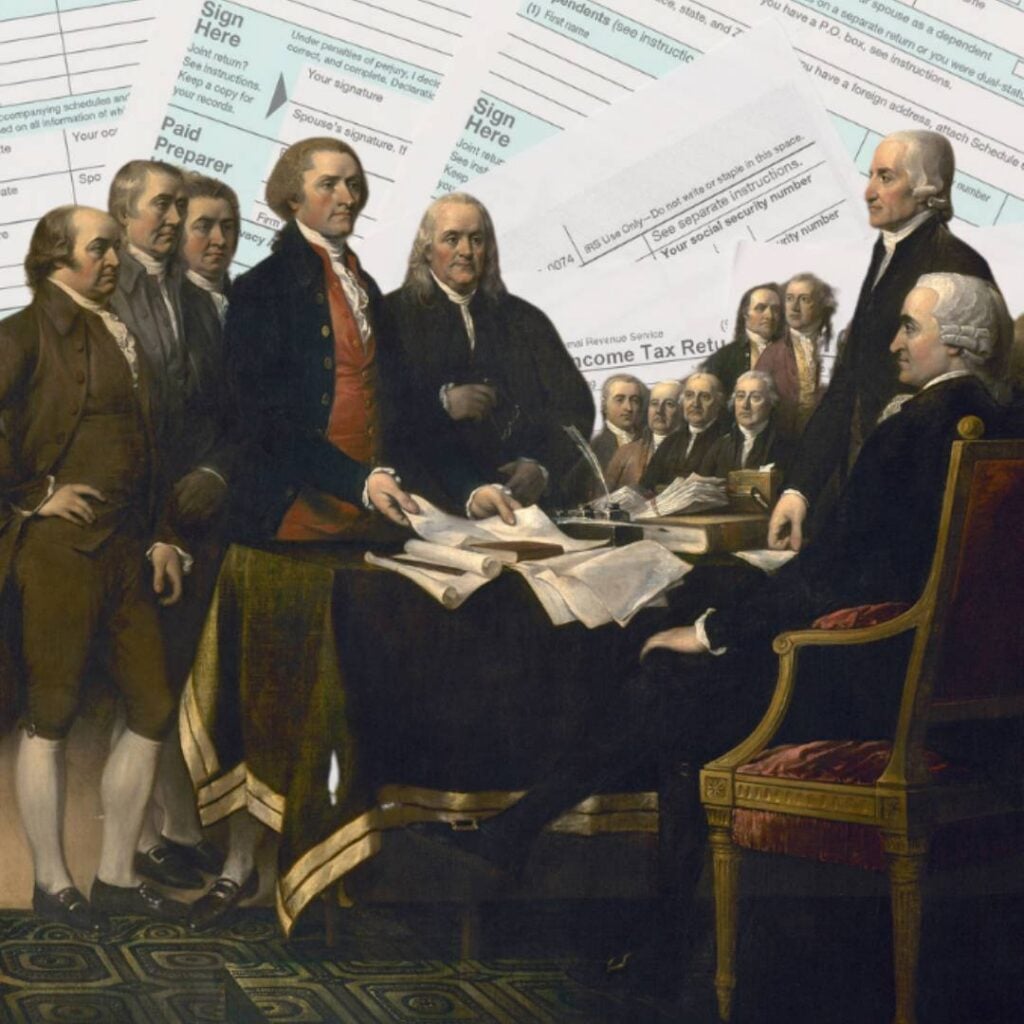
As America approaches its 250th birthday, the nation is reflecting not only on its founding principles but on how far policy has evolved from them. Among the most consequential shifts is the changing nature of tax policy, in particular the rise of wealth taxes, capital gains taxes and aggressive surtaxes across the country.
Last week, Tax Day arrived as a reminder of the complex, far reaching tax burdens Americans now shoulder. It shows how far we have moved from the Founders’ original vision of a limited, uniform tax system designed to protect property and preserve liberty. Today’s push for wealth taxes at the federal and state levels marks a profound departure from the principles that shaped early America. These proposals not only target assets in ways the Founders would have rejected, they also threaten the sector our framers intended to endure as a foundation of civil society-private philanthropy.
While the Founders didn’t oppose taxation, they did believe taxes must be limited, equal and tied to representation. Their experience under British rule, where taxes were imposed without consent, shaped their belief that taxation must protect liberty, not erode it. As the nation marks two and half centuries of independence, these principles remain central to understanding the debate over current tax policy.
Wealth taxes are a tax on an individual’s net worth rather than income. They have become a centerpiece of progressive policy, representing a dramatic expansion of government authority over private assets.
But just as important as their view of taxation was their expectation that civil society, not the state, would do much of the work of solving social problems. Early America was defined by churches, organizations and voluntary associations that provided education, relief and community support long before government programs existed.
Over time, our country has developed one of the most robust philanthropic sectors in the world. Private giving helped build:
- Universities such as Hillsdale College and Patrick Henry College;
- Hospitals and medical research institutions, such as Johns Hopkins Hospital;
- Museums, libraries and cultural centers such as Mount Vernon, Carnegie libraries and presidential libraries and
- Faith-based and community relief organizations, such as Samaritan’s Purse and HunterSeven Foundation.
Today’s tax policy increasingly focuses not just on income, but on assets and this represents a significant shift in the philosophy of taxation. As this shift accelerates, it also reshapes the environment in which philanthropy operates. Supporters of wealth tax argue it’s a matter of fairness, but the reality is more complicated. Such taxes reach across nearly every asset class from homes to retirement accounts, raising the risk of double taxation on assets already subject to property or income taxes. Even if lawmakers could agree on what qualifies as “wealth,” valuing it remains a persistent challenge: markets fluctuate, and many personal assets are inherently subjective. The result is a complex tax system.
In recent years, federal lawmakers have introduced sweeping legislation aimed at taxing millionaires and billionaires:
- Sen. Bernie Sanders and Rep. Ro Khanna have introduced the Make Billionaires Pay Their Fair Share Act, which proposes a 5% annual federal wealth tax on individuals with a net worth above $1 billion.
- Sen. Elizabeth Warren, Rep. Pramila Jayapal and Rep. Brendan Boyle have re-introduced the Ultra-Millionaire Tax Act of 2026, which proposes a 2% annual tax on wealth between $50 million and $1 billion, with a 3% annual tax on wealth exceeding $1 billion.
- Sen. Chris Van Hollen and Rep. Don Beyer re-introduced the Millionaires Surtax Act, which proposes a 10% surtax on income exceeding $1 million for individuals and $2 million for couples, covering wages, capital gains and investment income.
Across the country, states are introducing wealth taxes, capital gains taxes and surtaxes that collectively reshape the tax landscape and indirectly, the philanthropic one.
- California’s Billionaire Tax Act, backed by major labor unions, proposes a one‑time tax on billionaires to fund the state’s strained health care system.
The proposal has split California Democrats and sparked intense debate. Supporters say it would tap into the fortunes of roughly 200 billionaires, while critics warn it could drive wealth and investment out of the state.
- The Hawaii legislature introduced companion bills proposing a 1 percent annual tax on individuals with more than $20 million in assets. They have also introduced companion bills which would create an annual tax on high net-worth individuals.
- The Illinois legislature introduced the Extremely High Wealth Mark-to-Market Tax Act which would require individuals with $1 billion or more in net assets to pay taxes on unrealized gains.
- The Maine legislature introduced a bill that would tax residents at an annual rate of 2 percent for income over one million dollars.
- The Maryland legislature introduced the Ultra-High-Net-Worth Individual Surtax and Wealth Tax bill, which would create a one-time wealth tax on billionaires, in addition to creating a surtax.
- The Minnesota legislature introduced legislation that would establish an annual 1 percent wealth tax on individuals and trusts with taxable wealth exceeding $10 million.
- The New York legislature introduced companion Billionaire Mark-to-Market Tax Act bills that would require billionaires to pay tax on unrealized gains.
- The Rhode Island legislature introduced companion bills that seek to impose a 1 percent tax on the worldwide wealth of individuals and entities[MOU2] .
- The Vermont legislature introduced a bill to establish a wealth tax commission that would study Vermont’s current tax system and recommend future wealth tax proposals.
- Washington recently enacted a bill establishing a tax on individuals earning $1 million or more.
The Founders believed a government powerful enough to redistribute wealth was powerful enough to threaten liberty. Today’s tax proposals represent precisely the kind of targeted, non‑uniform taxation they sought to prevent.
Each year, Tax Day has become a yearly reminder of how far the nation has moved from its origins. The Founders imagined a country where taxation was a necessary but limited tool. Today, taxation has become a mechanism for wealth redistribution and political leverage.
The rise of wealth tax proposals, a once unthinkable idea in America, illustrates a profound philosophical shift and marks a departure from the principles that guided the Founders.
