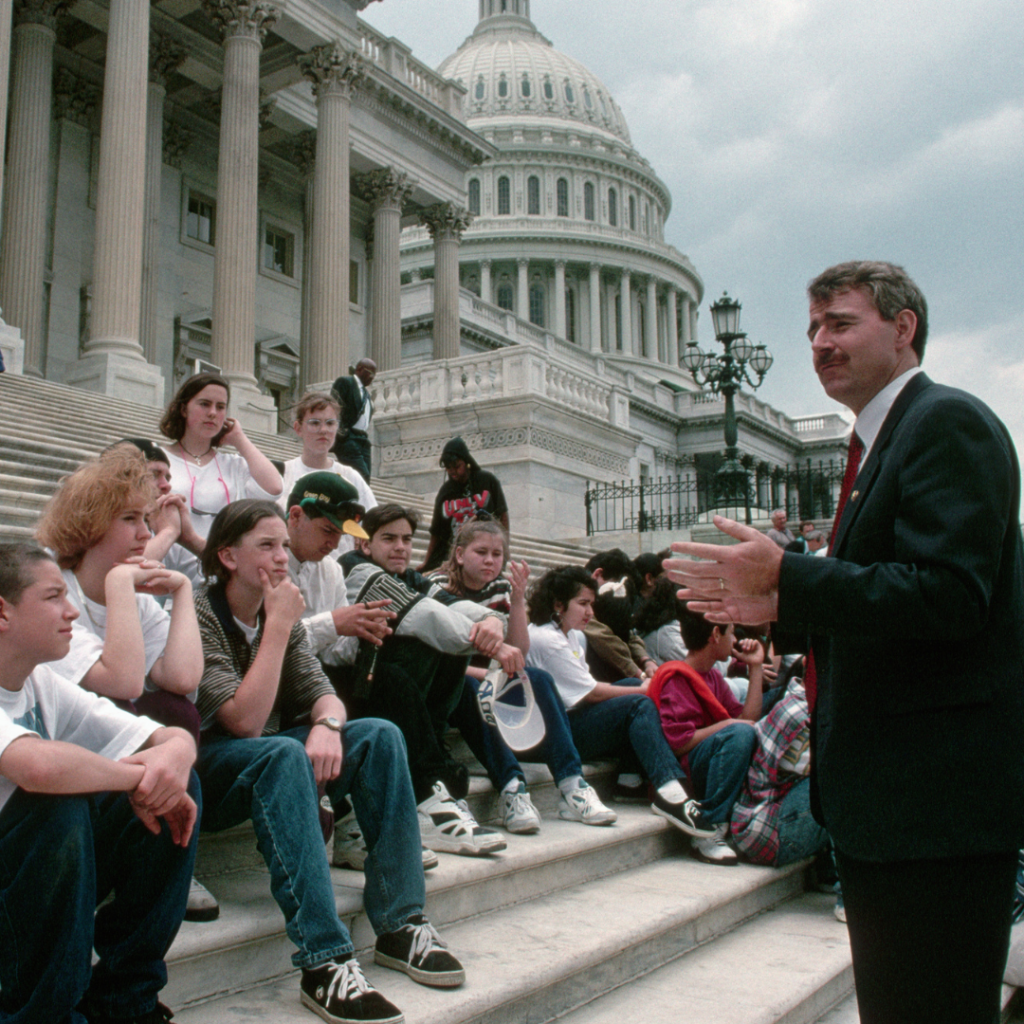
As the United States approaches the 250th anniversary of the Declaration of Independence, a growing number of educators, policymakers and philanthropists are asking a question that would have seemed obvious to the founders: What does it mean to prepare citizens for self-government?
For decades, many American universities stopped asking that question altogether.
Shared foundational learning gradually gave way to sprawling distribution requirements built around vague competencies and highly specialized electives. At many institutions, undergraduates can complete a degree without ever studying the American Founding, the Constitution or the enduring ideas that shaped the nation’s political tradition. Today, only 14 states require all public university undergraduates to complete even a single civics course.
But a serious movement to rebuild civic education inspired by the model legislation, the General Education Act (GEA), is beginning to take shape.
Behind the creation and momentum of the GEA is The James G. Martin Center for Academic Renewal, a higher education policy organization that has spent years studying the failures of contemporary general education and developing practical reform models for states and public universities.
What makes this movement unique is that it focuses not only on encouraging a strong civics curriculum but also on a renewed institutional structure to support it. And it is already producing tangible results.
Earlier this year, Texas Southern University and West Texas A&M University received a $1.9 million U.S. Department of Education grant to implement a new four-course civics sequence as part of an initiative called “The American Civic Tradition at 250.” The curriculum traces political thought from classical sources through the American Founding and into contemporary constitutional debates, with an emphasis on primary texts, civic responsibility and constitutional self-government.
Just months earlier, Utah enacted Senate Bill 334, legislation inspired by the GEA framework. The law seeks to restore a coherent liberal arts foundation centered on American history, civics, economics and foundational texts at Utah State University.
For years, higher-education reformers have struggled to strengthen civic education within university systems that often place competing pressures on general education. At many institutions, general education requirements also serve departmental enrollment needs, creating incentives to expand the number of courses that satisfy core requirements. Over time, this can produce a fragmented curriculum in which students share fewer common intellectual experiences centered on history, civics and foundational texts.
The GEA addresses this problem directly.
Rather than leaving foundational courses scattered across departments, the model proposes creating a single dedicated school or center for general education. That change alters incentives. A center devoted specifically to foundational learning exists to serve students and civic formation, not departmental enrollment goals.
This is why many reformers believe the current moment may prove more durable than previous attempts at civic renewal. The effort is not simply about adding a few new courses. It is about rebuilding the institutional foundations of general education itself.
For donors focused on civic renewal, that institutional focus is precisely what makes the effort compelling.
“The General Education Act model legislation is attracting renewed attention as the nation approaches its 250th anniversary,” said Janet Chiavetta, a longtime Martin Center donor. “For students to fully appreciate the benefits and responsibilities of constitutional self-government, they need a deeper understanding of America’s founding principles and institutions. The urgency of that work has never been clearer.”
General education reform does not affect a small honors cohort or a temporary initiative. It shapes the educational experience of every undergraduate who passes through an institution, often during the first semesters when intellectual habits and civic assumptions are still forming.
The GEA is designed to do exactly that: reach every student while also changing the underlying structure of the institution itself. For philanthropists focused on civic renewal, that combination of scale and durability is rare.
The emergence of the GEA also illustrates how philanthropic investment in policy entrepreneurship can shape institutional reform over time. The Martin Center is not alone in this work. Organizations like the American Council of Trustees and Alumni (ACTA) have spent decades advocating for stronger civics requirements at public universities and documenting how little many graduates know about American history and government.
The work is also continuing to expand. The next phase of the GEA effort is to identify deficiencies in general education curricula at additional public universities and work with policymakers to develop state-specific reform proposals. Later this month, the Martin Center will release a “Blueprint for Wyoming”, which will outline the case for general education reform in the Cowboy State and explore how the model could be adapted to Wyoming’s higher education system.
While not every effort is yet public, reformers are actively exploring opportunities in other states, reflecting growing interest in restoring civic and historical education through durable institutional change.
At a moment when many philanthropists are concerned about civic fragmentation, declining historical literacy and weakening institutional trust, the effort to restore serious civic education represents something increasingly rare: a reform capable of reaching entire institutions and generations of students.
Career preparation will always matter. Universities should equip students with practical skills and professional opportunities. But to maintain a strong civil society, it is critical that its citizens are capable of constitutional reasoning, historical understanding and thoughtful participation in public life.
For much of American history, civics education was understood as one of higher education’s central responsibilities, and as America approaches its 250th year, a growing number of reformers are working to recover that tradition.
For more information about the James G. Martin Center for Academic Renewal or how the Roundtable supports Higher Ed reform and civics education, please contact Senior Director of American Values & Policy Philanthropy Clarice Smith.
