Executive Summary
Nonprofits are a pillar of American civil society rooted in the constitutional freedom of association and animated by the Tocquevillian ideal of voluntary, community-based action. Today, there are over 1.8 million organizations delivering essential services and strengthening communities nationwide in ways the government cannot or should not. Yet, this vibrant ecosystem faces a growing challenge: increasing reliance on government funding, which threatens nonprofit independence.
As public grants, contracts, and subsidies become central to nonprofit operations, many organizations risk acting as bureaucratic arms of the state rather than independent, mission-driven, and community-oriented entities. This concern was sharply underscored by the January 2025 freeze of federal grants, which exposed how deeply some nonprofits rely on public dollars—and how vulnerable they are to political shifts and executive overreach.
Key Points:
- Nearly one-third of nonprofit revenue came from government sources in 2021-2023.
- Large nonprofits with expenditures exceeding $1 million report almost half their revenue comes from government funding.
- Since 2008, federal grants made to nonprofits have more than doubled, with most of that growth occurring since 2019.
- Studies suggest government funding crowds out private giving. For example, government dollars may crowd out fifty cents or more in private charitable contributions to social service organizations.
Heavy reliance on government funding reshapes nonprofit priorities and raises operating costs, moving many away from local responsiveness and innovation, and toward compliance with bureaucratic mandates.
Consequences:
- Loss of Mission Integrity and Flexibility: Nonprofits may drift from their founding purposes to meet government criteria, reducing creativity and weakening community ties.
- Erosion of Accountability and Civic Role: Increased government oversight and weakened board engagement undermine nonprofit autonomy and the sector’s function as a civic check on government.
- Decline in Private Giving and Sector Diversity: Public funds often displace private donations and favor larger institutions, crowding out local organizations and reducing pluralism in civil society.
A resilient civil society is the foundation of a pluralistic and self-governing nation. Nonprofit leaders and policymakers should work to reduce the structural dependency on government funds to ensure the nonprofit sector can remain dynamic, community-driven, and free to challenge the status quo. Balancing the benefits of public funding with the need for independence is essential for preserving the integrity, effectiveness, health, and longevity of the charitable sector. An independent nonprofit sector is not just a legacy of American democracy, it is essential to its future.

Introduction
The United States is more than just a government and its citizens—it is home to a vibrant and intricate landscape of individuals driven by diverse causes and passions. The constitutional right to freedom of association allows Americans to organize based on their shared interests, and this right is the backbone of the American nonprofit sector. Woven into the fabric of American society, 1.8 million nonprofit organizations span every corner of the nation, transcending age, gender, race, and socioeconomic status.
These organizations are vital to communities, providing food for the hungry, medical care for the ailing, shelter for the homeless, and educational opportunities for all. From bustling urban centers to remote rural areas, nonprofits serve as catalysts for positive change, fostering civic engagement, nurturing leadership, embodying the social goals of citizens, and fortifying social bonds that hold neighborhoods together.
This spirit of voluntary association, which Alexis de Tocqueville famously observed nearly two centuries ago, is a defining feature of American democracy. Through voluntary association into the network we call civil society, Americans express their priorities, driving social change on issues from the abolition of slavery to women’s suffrage and, more recently, efforts to expand school choice and educational freedom. Nonprofits have historically filled gaps that government cannot or should not address, providing nimble and innovative support to causes and communities across the country.
Nonprofit organizations rely on a diverse array of funding sources to support their missions and operations. These sources include charitable donations from individuals, foundations, and corporations, which form the backbone of many nonprofits’ financial support. In addition to voluntary giving, nonprofits often generate revenue through program service income, such as proceeds from thrift stores like Goodwill or fees from events like conferences or proceeds from museum gift shops. Many organizations also benefit from investment income, utilizing their endowments or other assets to fund ongoing activities for generations to come.
For an increasing number of organizations, a key source of funding is government support, which can come in the form of grants, contracts, or direct subsidies aimed at advancing public policy goals.
While these funding streams help support nonprofit activities, an increasing dependence on government funding has raised concerns about the potential for mission drift and reduced autonomy within civil society.
Excessive involvement of federal and state agencies and growing dependence on government funds risks eroding civic engagement, creating a passive citizenry reliant solely on government programs. Counter to the very core of America, this would be a departure from the Tocquevillian ideal of a thriving, self-reliant civil society, one that balances limited government with active citizen participation in solving societal challenges.
Now more than ever, the dangers of nonprofits’ growing government dependence are evident. The Trump administration’s January 2025 memorandum freezing grants, loans, and financial assistance to nonprofits exposed just how fragile and misguided this dependency has become.1Office of Management and Budget (OMB). January 27, 2025. MEMORANDUM FOR HEADS OF EXECUTIVE DEPARTMENTS AND AGENCIES. https://www.politico.com/f/?id=00000194-ae0c-dd75-adfc-af8f40e50000
A last-minute judicial stay and the Office of Management and Budget’s subsequent rescission temporarily halted components of the freeze, as of this writing. But the incident highlights an underlying problem: nonprofits that rely on government largesse are at the mercy of political whims and bureaucratic decrees rather than being accountable to their donors, communities, and the people they seek to serve.
This paper explores the tension between the Tocquevillian ideal of independent voluntary associations and the issues associated with overreliance on government funding. It begins by examining the theoretical framework of Alexis de Tocqueville, who emphasized the importance of nonprofit organizations’ autonomy in strengthening democracy. The paper then reviews available data on the increasing share of government funding in the nonprofit sector, followed by a deep dive into the empirical literature that highlights the challenges associated with this funding model.
These challenges include the bureaucratization of nonprofits, the shift from charitable missions to government priorities, the emergence of rent-seeking behavior, and the erosion of organizational independence. Additionally, the paper will examine studies on how government funding may crowd out private charitable donations, further exacerbating nonprofits’ dependence on public resources.
The Independent Sector and Tocquevillian Civil Society
Alexis de Tocqueville, in his seminal work, “Democracy in America,” identified voluntary associations as critical to the health of democratic societies.2Tocqueville, Alexis de., Alexis. Democracy in America. 1835. He believed these associations, which operated outside the sphere of government and economic life, constituted what we now call civil society. According to Tocqueville, these associations served as essential bulwarks against democratic decay and despotism by fostering social trust, cultivating civic virtues, and enabling collective action independent of centralized power. However, the increasing reliance of nonprofit organizations on government funding poses a serious challenge to the historical underpinning of American civil society.
Tocqueville regarded civil society as a counterbalance to both the market and the state. By forming and sustaining voluntary associations, individuals learned the habits of cooperation, self-governance, and mutual accountability. These associations empowered citizens to address local problems and advocate for shared interests without requiring top-down interventions. In Tocqueville’s view, the vibrancy of civil society was essential to prevent the concentration of power in government, which could lead to despotism, or the atomization of individuals, which could result in social stagnation.
When nonprofits become increasingly reliant on government funding, the independence and autonomy Tocqueville prized in civil society is undermined. Government grants and contracts often come with strings attached, dictating how funds must be used and what activities are permissible. This reliance transforms nonprofits from independent actors into quasi-governmental entities beholden to political priorities rather than community needs or creative, tailored solutions. Instead of serving as a check on state power, these organizations risk becoming instruments of it.
Government funding can distort the priorities and strategies of nonprofits. Rather than responding to the grassroots needs of their communities, organizations may align their activities with government mandates to secure funding. This shift weakens the organic, bottom-up nature of civil society that Tocqueville admired. Nonprofits driven by government incentives may prioritize compliance over innovation, bureaucracy over responsiveness, and short-term funding cycles over long-term impact.
The increasing dependence on government funding also raises concerns about pluralism within civil society. Tocqueville celebrated the diversity of associations as a reflection of the multiplicity of interests and values within a democratic society. However, government funding often favors large, well-established organizations with the administrative capacity to navigate complex grant processes. Smaller, grassroots nonprofits may struggle to compete, resulting in a homogenization of civil society that stifles the diversity Tocqueville deemed essential to democracy.
Furthermore, the reliance on government funding blurs the boundaries between civil society and the state. This erosion of distinct spheres undermines the capacity of nonprofits to act as watchdogs and critics of government policies. Tocqueville saw civil society as a space for citizens to organize independently of state control, providing a critical check on government power.
When nonprofits depend on government funding for their survival, their ability to critique policies or advocate for change is compromised. Fear of biting the hand that feeds them may lead to self-censorship and a reluctance to challenge authority. This dynamic might explain, at least in part, why we have witnessed a 31 percent decline in nonprofit advocacy over the past twenty years3Tanner, Patterson. Study Shows Nonprofit Advocacy and Public Engagement are on the Decline. Philanthropy Roundtable. October 23, 2023. https://www.philanthropyroundtable.org/study-shows-nonprofit-advocacy-and-public-engagement-are-on-the-decline/ Finally, the increasing reliance on government funding risks fostering public cynicism about the nonprofit sector. Nonprofits that operate as extensions of government are less likely to inspire trust and engagement from citizens. Tocqueville observed that voluntary associations thrived on the active participation and commitment of individuals who felt a sense of ownership over their endeavors.
When nonprofits are perceived as bureaucratic and state-driven, they lose their appeal as vehicles for community empowerment, further eroding the Tocquevillian ideal of civil society. Indeed, current skepticism about the value of nonprofits may lead to increased policy restrictions or requirements for nonprofits as lawmakers seek to explicitly limit the role of a free civil society.
Tocqueville’s vision of civil society as a vibrant, independent sphere of collective action is threatened by the growing reliance of nonprofits on government funding. This trend risks undermining the autonomy, diversity, and accountability of the nonprofit sector, turning it into an arm of the state rather than a counterbalance to government power.
When nonprofits depend on government funding for their survival, their ability to critique policies or advocate for change is compromised.

Government Funding of Nonprofits: The Scale
Over the years, and especially since the 1990s, nonprofit organizations have received a growing share of funding from government sources. A large share of nonprofits, particularly in subsectors such as human services, health, and education, receive funds from government sources to deliver services on behalf of state, local, and federal agencies.
Comprehensive data on the scale of government funding of nonprofits is limited due to the complexity of channels through which government funds reach nonprofit organizations. For example, federal grants might flow directly to universities, while state grants might be disbursed to local governments which reward nonprofits for their services.
In addition, indirect costs are often not captured in official data records, such as Medicaid reimbursements for hospitals, which are categorized as “program service” revenue (or fee-for-service) rather than government funding sources. Prior attempts to quantify the scale of government funding of nonprofits found federal funding to be an estimated $317 billion in fiscal year 2004.4Abramson, Alan, Lester Salamon, and C. Eugene Steurle, “Federal Spending and Tax Policies: Their Implications for the Nonprofit Sector,” Nonprofits and Government, 2nd Edition, eds. E. Boris and C. E. Steurle (Washington, DC: The Urban Institute Press, 2006), p. 118.
Breaking government funding down by direct grants and fee-for-service, a review of nonprofit revenues for 2010 found $171 billion in government grants and $492 billion in fee-for-service revenues (including Medicare, Medicaid, and government contracts) for a total of $663 billion, or almost one-third of all nonprofit revenues.5Blackwood, Amy S., Katie L. Roeger, and Sarah L. Pettijohn. “The Nonprofit Sector in Brief: Public Charities, Giving, and Volunteering, 2012.” Urban Institute, 2012. This analysis reveals fee-for-service revenues from government can be as much as three times the value of government grants, which the IRS does provide data on.
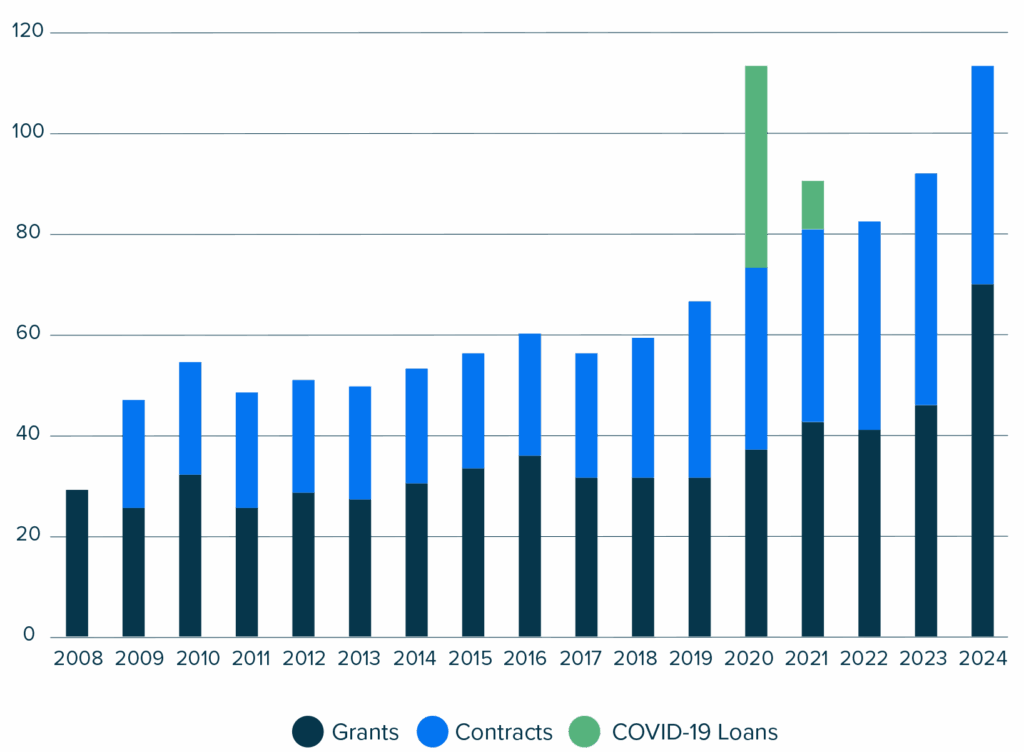
The first chart below (Chart 1) shows federal agency grantmaking and contract data for the years 2008 through 2024. The data is sourced from usaspending .gov, under the Department of Treasury’s Bureau of the Fiscal Service. This dataset tracks direct federal spending on grants to nonprofits, meaning it only accounts for grants awarded and administered by federal agencies.
Notably, federal grants and contracts in 2024 reached peak levels last seen during the COVID-19 pandemic crisis. The figures reflect federal grants directly reported by U.S. government departments and agencies. These data represent the narrowest definition of government funding to nonprofits, demonstrating only the tip of the iceberg.
Chart 1. Federal Agency Funding of Nonprofit Organizations (Billions of USD): 2008-2024
View Data Table
| Year | Grants | Contracts | COVID-19 Loans |
|---|---|---|---|
| 2008 | $12.1 | $16.8 | |
| 2009 | $25.5 | $21.4 | |
| 2010 | $32.1 | $22.2 | |
| 2011 | $25.8 | $22.6 | |
| 2012 | $28.5 | $22.5 | |
| 2013 | $27.1 | $22.4 | |
| 2014 | $30.3 | $22.9 | |
| 2015 | $33.2 | $23.0 | |
| 2016 | $35.8 | $24.2 | |
| 2017 | $31.5 | $24.9 | |
| 2018 | $31.4 | $27.8 | |
| 2019 | $31.3 | $35.3 | |
| 2020 | $37.0 | $36.2 | $40.1 |
| 2021 | $42.6 | $38.0 | $9.9 |
| 2022 | $41.1 | $41.3 | |
| 2023 | $45.8 | $46.2 | |
| 2024 | $69.9 | $43.4 |
The second chart below (Chart 2) is from Internal Revenue Service (IRS) Statistics of Income (SOI) data. These data capture a broader range of federal grants to nonprofit organizations as reported on form 990 filings from 1991 through 2021. However, nonprofits often categorize government funding from service contracts as program service revenue instead of government grants, which can cause underreporting if only “grants” are tallied.
For instance, hospitals and universities receive significant government funds (e.g., medical reimbursements, research contracts) but classify this revenue as payment for services, not grants. As noted earlier, government fee-for-service revenues can be three times larger than total government grants to nonprofits. While the observable spike in funding in 2020 may largely reflect an increase in government funds to nonprofits in response to the COVID-19 crisis, the upward trajectory was already notable in 2019 and continues through 2021.
Chart 2. Federal Government Grants to Nonprofit Organizations (Billions of USD): IRS Data 1991-2021

View Data Table
| Year | Federal Grants |
|---|---|
| 1991 | $38.8 |
| 1992 | $41.1 |
| 1993 | $46.4 |
| 1994 | $52.0 |
| 1995 | $53.0 |
| 1996 | $57.0 |
| 1997 | $59.6 |
| 1998 | $64.6 |
| 1999 | $68.8 |
| 2000 | $79.4 |
| 2001 | $88.7 |
| 2002 | $95.4 |
| 2003 | $99.7 |
| 2004 | $105.6 |
| 2005 | $112.9 |
| 2006 | $115.0 |
| 2007 | $123.8 |
| 2008 | $131.0 |
| 2009 | $140.6 |
| 2010 | $155.1 |
| 2011 | $154.1 |
| 2012 | $153.7 |
| 2013 | $159.3 |
| 2014 | $167.7 |
| 2015 | $167.9 |
| 2016 | $178.3 |
| 2017 | $183.4 |
| 2018 | $184.5 |
| 2019 | $222.7 |
| 2020 | $301.4 |
| 2021 | $314.0 |
Another approach of measuring the scale of government funding to nonprofit organizations is to ask a large sample of organizations to identify what share of
their program service revenue comes from government sources. Using large surveys or sampling data better reflects the true extent of government funding of nonprofit organizations. Reviewing survey data for the years 2021-2023 reveals almost one-third of nonprofit revenue came from government sources (federal, state, and local).6Martin, Hannah, Elizabeth T. Boris, Laura Tomasko, Jesse Lecy, Lewis Faulk, and Mirae Kim. “Nonprofit Trends and Impacts 2021–2023 National Findings on Government Grants and Contracts from 2019 to 2023.” Urban Institute, 2024. Larger nonprofits are more dependent on government funding. Organizations with expenditures exceeding $1 million receive almost half their revenue through government funding. In terms of sectoral breakdown, education, health, and human services are the sectors most dependent on government funding. These estimates are consistent with prior reports finding that 31.8 percent of revenue sources come from government grants/contracts.7“Nonprofit Impact Matters: How America’s Charitable Nonprofits Strengthen Communities and Improve Lives.” National Council of Nonprofits, 2019. https://www.nonprofitimpactmatters.org/.
Using survey and sampling data to inform the inquiry, we can assume about $3 in every $10 of nonprofit revenue comes from government sources, on average. This does not account for nonprofits that do not accept government funding, so this figure is likely higher for those that do.
In this case, the total amount of government funding to nonprofits was likely closer to $900 billion in 2021 than the roughly $300 billion in government grants reported by IRS data.
Fee-for-service revenues from government can be as much as three times the value of government grants.

Changes in Funding Rules Likely to Increase Government Funding Dependency
While nonprofit organizations receive about one-third of their revenues from government funds, recent regulatory changes are likely to grow this share even further. Take for example, the Office of Management and Budget’s (OMB) revisions to guidance for federal funds under the former Biden administration.8OMB. “Guidance for Grants and Agreements.” Office for Management and Budget, 2023. https://www.regulations.gov/document/OMB-2023-0017-0001. The changes enacted in October 2024 include allowing nonprofits receiving government funds to claim an increased de minimis indirect cost rate for “indirect costs.”
Indirect costs are expenses like rent, utilities, and administrative support that aren’t directly tied to a specific project but are additional operational costs outside of direct project costs. Prior to October 1, 2024, nonprofit organizations that receive federal funds could add an extra 10 percent to cover these indirect costs without going through a complex negotiation. The OMB has now increased this additional federal subsidy to 15 percent.
While this may seem like a small regulatory change in guidelines, it is problematic for several reasons. First, it encourages dependency on federal funding. Increasing the de minimis rate to 15 percent makes it easier for organizations to rely on federal funds for a larger portion of their operational costs. This could incentivize more groups to seek federal funding rather than pursuing alternative private funding, which ultimately expands the role of government in financing and potentially influencing these organizations.
Second, it increases the fiscal burden on the taxpayer. Raising the rate means taxpayers could be footing a larger bill, as more federal funds will be directed to cover overhead costs for organizations. This could lead to increased federal spending or a reallocation of limited resources, with the former adding even more to the financial burden on taxpayers or the latter potentially leading to inefficiencies in how federal funds are allocated.
Third, it expands government involvement in nonprofit operations. This change deepens the connection between government funding and the nonprofit sector. With increased government funding comes higher regulatory burdens and administrative requirements, which could undermine nonprofits’ independence and shift their focus away from the missions. Finally, it sets a precedent for future increases.
Raising the de minimis rate sets a precedent that this rate can be adjusted upward, potentially leading to further increases in the future. This opens the door to a gradual growth in government subsidies for administrative expenses, leading to mission creep and an unnecessary escalation of government spending and involvement.
For example, federal grants for nonprofit colleges initially had an 8 percent cap for overhead costs, which was subsequently raised to 15 percent in the 1970s, raised again to 20 percent in the 1980s, and then uncapped in 1991 for “facility costs.”9Greene, Jay. “The Poison Ivy League: How Taxpayers Subsidize Wealthy Universities.” The Heritage Foundation, February 2024. As a result, some Ivy League colleges now spend 60 percent or more on overhead/administrative costs. The same risk applies to the nonprofit sector at large as it relates to federal funding of indirect costs.

The Risks of Overdependence on Government Funds
Economist Milton Friedman once said, “One of the greatest costs of our present welfare system is [it] poisons the springs of private charitable activity.”10Friedman, Milton, and Rose Friedman. Free To Choose: A Personal Statement. Harcourt, 1980. Friedman highlights a central concern—that a growing size and role of government (especially social welfare spending) in the charitable space risks unintentionally undermining private charitable activity and individual responsibility. In Friedman’s view, charity is not just about financial assistance; it also fosters strong community bonds and social trust.
The growing size and scope of government in this space risks replacing the interpersonal connections that arise from private giving and mutual aid with impersonal bureaucratic processes. For example, the COVID-19 pandemic propelled U.S. charitable giving in 2020 to the highest level on record at that time. The increase in charitable donations was most concentrated in parts of the country hardest hit by the pandemic.
A study found charitable giving increased in 78 percent of counties that experienced the greatest threat from COVID-19, helping mitigate the effects of the pandemic. Overdependence on government funds could undermine the role of local institutions, such as churches, community groups, and philanthropic organizations, which traditionally serve as vehicles for community-based support.
Bureaucratization
Government funding is frequently accompanied by stringent evaluative and regulatory provisions designed to ensure accountability and consistency in service delivery. These provisions often include requirements for financial management, adherence to accounting standards, meeting minimum quality benchmarks, alignment with core program goals, and compliance with national policy priorities such as environmental sustainability and equal opportunity.11Krashinsky, Michael. “Management implications of government funding of nonprofit organizations: Views from the United States and Canada.” Nonprofit Management and Leadership 1, no. 1 (1990), 39-53.
Navigating these regulatory and procedural demands necessitates a shift from reliance on volunteers to a dependence on skilled professional staff. There are of course myriad reasons why a nonprofit may employ a skilled professional staff to ensure effectiveness in meeting their mission. However, forcing a diversion of resources away from organizational goals and toward navigating government bureaucracy does present significant concerns.
The labor-intensive compliance work associated with government support also drives up operational costs for nonprofits. Processes such as reporting and accounting for government funds demand significant time and resources.12 Larger nonprofits often employ dedicated staff whose primary responsibilities involve securing, managing, and reporting on government grants and contracts. This administrative burden has measurable effects: Frumkin and Kim found a 1 percent increase in government funding correlates with a 2.1 percent rise in the share of administrative to total expenses, directly reflecting increased bureaucratic inefficiency.12Frumkin, Peter, and Mark T. Kim. “The Effect of Government Funding on Nonprofit Administrative Efficiency: An Empirical Test.” Ash Institute for Democratic Governance and Innovation, 2002. Empirical studies further support the link between government funding and bureaucratic orientation. A survey of human service nonprofits in Maryland revealed organizations with a history of government funding and stronger alignment with governmental priorities are more likely to receive government contracts and grants, reinforcing a feedback loop that perpetuates bureaucratization.13Lu, Jiahuan. “Which Nonprofit Gets More Government Funding?” Nonprofit Management and Leadership 25, no. 3 (2015), 297-312.
Mission Drift and Co-Optation
As public funding becomes central to organizational survival, nonprofits risk shifting their goals to align more closely with government priorities. Wolch described this phenomenon as a form of co-optation, whereby nonprofits become quiescent, prioritizing their survival over advocacy or innovation.14Wolch, Jennifer R. The Shadow State: Government and Voluntary Sector in Transition. 1990. Smith and Lipsky said nonprofits heavily reliant on government funding often reorient their programs and planning processes to meet governmental objectives, resulting in reduced advocacy for new services and a focus on lobbying for increased funding for existing programs.15Smith, Steven R., and Michael Lipsky. Nonprofits for Hire. Cambridge: Harvard University Press, 1993.
Organizations that should serve as critical voices and innovators instead become extensions of the state, limiting the range of ideas and solutions available to address social challenges.
This dynamic weakens the independence and pluralism essential for a strong and diverse civil society. Organizations that should serve as critical voices and innovators instead become extensions of the state, limiting the range of ideas and solutions available to address social challenges.
This mission drift is evident in qualitative studies. For example, Alexander, Nank, and Stivers found that nonprofits in Cuyahoga County, Ohio, redirected resources from service delivery and advocacy toward administrative activities such as grant-writing and documenting community needs.16Alexander, Jennifer, Renee Nank, and Camilla Stivers. “Implications of Welfare Reform: Do Nonprofit Survival Strategies Threaten Civil Society?” Nonprofit and Voluntary Sector Quarterly 28, no. 4 (1999), 452-475. Such shifts diminish the capacity of nonprofits to engage in creative or innovative activities.
The impact of government funding on nonprofit governance is equally significant. O’Regan and Oster observed that board members of government-funded nonprofits are less likely to engage in private fundraising or contribute personally, perceiving their support as less necessary due to the availability of public funds.17O’Regan, Katherine, and Sharon Oster. “Does Government Funding Alter Nonprofit Governance? Evidence from New York City Nonprofit Contractors.” Journal of Policy Analysis and Management 21, no. 3 (2002), 359-379.
Additionally, reliance on government funding decreases the likelihood of developing boards that are closely aligned with the mission and constituents of the organization. Mission alignment is important for ensuring responsiveness to major stakeholders, including clients, donors, and community members.18Guo, Chao. “When Government Becomes the Principal Philanthropist: The Effects of Public Funding on Patterns of Nonprofit Governance.” Public Administration Review 67, no. 3 (2007), 458-473. These changes constrain nonprofits’ democratic roles and reduce their effectiveness as advocates for social change.
Diminished Independence and Autonomy
The reliance on government funding often undermines the independence and uniqueness of nonprofits. Lenkowsky said overdependence on public resources could lead to diminished service quality, accountability issues, and reduced sectoral diversity.20 Jung and Moon found similar patterns among Korean cultural nonprofits, where public funding constrained managerial autonomy in goal setting, resource allocation, and program choices.19Jung, Kwangho, and M. J. Moon. “The Double-Edged Sword of Public-Resource Dependence: The Impact of Public Resources on Autonomy and Legitimacy in Korean Cultural Nonprofit Organizations.” Policy Studies Journal 35, no. 2 (2007), 205-226. Government funding imposes ex ante and ex post constraints, including input controls, performance evaluations, audit requirements, and a range of rules and regulations. These constraints disproportionately limit the operational and managerial autonomy of international nongovernmental organizations.20Chikoto, Grace L. “Government Funding and INGO Autonomy: From Resource Dependence and Tool Choice Perspectives.” Georgia State University, Fall 2010.
Similarly, Verschuere and Corte said nonprofits with closer financial ties to government report reduced autonomy in strategic decision-making, such as defining missions, determining target groups, and setting procedural goals.21Verschuere, Bram, and Joris De Corte. “The Impact of Public Resource Dependence on the Autonomy of NPOs in Their Strategic Decision Making.” Nonprofit and Voluntary Sector Quarterly 43, no. 2 (2014), 293-313. These findings align with resource dependence theory, which says organizations reliant on a single dominant funding source are more likely to conform to the priorities and accountability standards imposed by that source.
This body of literature underscores the profound and multifaceted impact of government funding on nonprofit organizations. While public funding provides revenues for a large share of nonprofit organizations, it also drives bureaucratization, diverts nonprofits from their original missions, and diminishes their autonomy.
Reliance on government funding decreases the likelihood of developing boards that are closely aligned with the mission and constituents of the organization.

Does Government Funding Crowd Out Private Donations?
Related to the literature on government funding undermining the independence and mission focus on nonprofit organizations is the “crowd-out hypothesis.” Economists and social scientists have long explored this hypothesis—the question of whether government funding of nonprofits displaces private charitable contributions.
Much of the early literature on this question suggests government funding does crowd out private donations, but the scale of crowd-out depends on a number of approaches and assumptions. Some research from the 1970s and 1980s suggested government funding causes partial crowd-out, with each dollar of government funding crowding out private donations by about thirty or forty cents.22Abrams, Burton A., and Mark D. Schitz. “The ‘Crowding-Out’ Effect of Governmental Transfers on Private Charitable Contributions.” Public Choice, vol. 33, no. 1, 1978, pp. 29–39; Abrams, Burton A., and Mark D. Schitz. “The ‘Crowding-Out’ Effect of Governmental Transfers on Private Charitable Contributions: Cross-section Evidence.” National Tax Journal 37, no. 4 (1984), 563-568. Other empirical explorations of this hypothesis estimated full crowd-out, with each dollar of government funding causing private donations to decline by one dollar.23Warr, Peter G. “Pareto Optimal Redistribution and Private Charity.” Journal of Public Economics, Vol 19, Issue 1, 1982, pp 131-138; Russell D. Roberts. “A Positive Model of Private Charity and Public Transfers.” Journal of Political Economy, Vol. 92, No. 1 (1984), pp. 136-148. Similarly, in the 1990s, much of the empirical literature suggested crowd-out existed, but it was more likely partial than full crowd-out. Weinblatt found each additional percentage increase in government transfers reduced private transfers by 0.40 percent, Andreoni found average crowding out of seventy-two cents on the dollar, and Brunner found a much more modest crowd-out of just nine cents on the dollar.24Weinblatt, J. “Do Government Transfers Crowd out Private Transfers to Nonprofit Organizations? The Israeli Experience.” International Journal of Social Economics 19, no. 2 (1992), 60-66; Andreoni, James. “An Experimental Test of the Public-Goods Crowding-Out Hypothesis.” The American Economic Review 83, no. 5 (1993), pp. 1317-1327; Brunner, Eric J. “An Empirical Test of Neutrality and the Crowding-Out Hypothesis.” Public Choice 92, no. 3 (1997).
Economist Arthur Brooks attempted to summarize the literature to test the crowd out hypothesis using various economic techniques. Brooks concluded by saying “crowding out seems to be a dominant effect especially in social/human service provisions and health services. … In no case was there any significant evidence of crowding in.”25Brooks, Arthur C. “Is There a Dark Side to Government Support for Nonprofits?” Public Administration Review 60, no. 3 (2000), 211-218. Additional studies testing the crowd-out hypothesis have focused on how government influences fundraising activity, as well as donative behavior. For example, Dokko observes the effects of government grant funding to the arts, finding private donations were crowded out by fifty-one to fifty-eight cents to the dollar, while fundraising was reduced by twenty-five to thirty-eight cents.26Dokko, Jane K. “Does the NEA Crowd Out Private Charitable Contributions to the Arts?” National tax journal 62.1 (2009): pp 57–75.
These estimates are consistent with Yetman and Yetman who found each additional dollar of revenue from government sources crowds out approximately fifty-five cents of donations to arts, culture, and humanities organizations and human services and public benefit organizations.27Yetman, Michelle H., and Robert J. Yetman. “The Effect of Nonprofits’ Taxable Activities on the Supply of Private Donations.” National Tax Journal 56, no. 1.2 (2003), 243-258. Andreoni and Payne find that when taking into account the impacts of government grants on charity fundraising, the crowd out effect is significant, at about seventy-six cents (driven primarily through reduced fundraising).28Andreoni, James & Payne, A. (2010). “Is Crowding Out Due Entirely to Fundraising? Evidence from a Panel of Charities.” Journal of Public Economics. 95, pp 334-343. Therefore, increased government funding not only reduces private donations from donors, it also discourages nonprofits from raising donations from non-government sources. Summarizing the findings of over fifty studies, Witt and Bekkers say two-thirds of the findings show crowd out of private donations, and across all findings the average is a modest seventeen cents on the dollar.29Wit, Arjen de, and Bekkers, René. “Government Support and Charitable Donations: A Meta-Analysis of the Crowding-out Hypothesis.” Journal of Public Administration Research and Theory, Vol 27, Issue 2, April 2017, pp 301–319. Comprehensive analysis seems to suggest government funding of nonprofit organizations leads to at least modest and partial crowd out of private philanthropy, whether through donative or fundraising behavior. Greater levels of crowd out are likely for government funding of social/human service organizations.
Increased government funding not only reduces private donations from donors, it also discourages nonprofits from raising donations from non-government sources.

Conclusion
While government funding provides a significant source of revenue for many organizations, it also introduces challenges that can undermine the mission and independence of these nonprofits. The bureaucratization of operations, shifting organizational priorities to align with government objectives, and the erosion of autonomy are all critical risks associated with overreliance on government support. Empirical evidence highlights these concerns, showing how compliance demands drive up administrative costs, while mission drift and co-optation diminish the innovative and advocacy roles of nonprofits.
Furthermore, the crowd-out hypothesis shows government funding often displaces private charitable contributions, not only reducing donations but also discouraging fundraising efforts. This crowding out effect, particularly pronounced in human service organizations, underscores the unintended consequences of expanding government support for the nonprofit sector.
Ultimately, overdependence on government funding threatens to transform nonprofits into mere extensions of government bureaucracy, eroding their independence, reducing sectoral diversity, and diminishing the interpersonal connections fostered through private giving. Nonprofit leaders must remain vigilant to ensure the nonprofit sector retains its vital role as a dynamic, community-driven force for social good, free from the constraints of excessive government intervention and dependence. Balancing the benefits of public funding with the need for independence will be essential for preserving the integrity and effectiveness of the nonprofit sector.