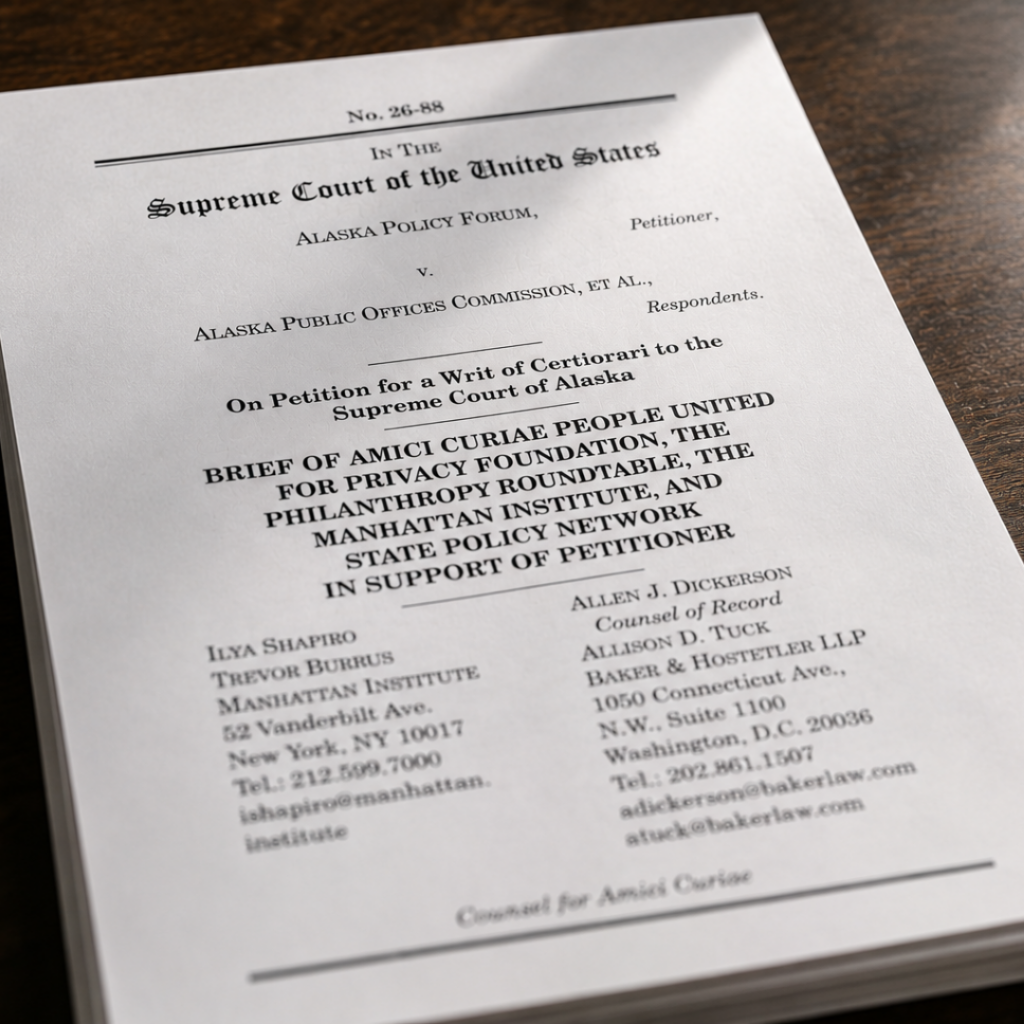
Philanthropy Roundtable has joined with People United for Privacy Foundation, the Manhattan Institute and State Policy Network in filing an amicus brief asking the Supreme Court to hear Alaska Policy Forum v. Alaska Public Offices Commission. The case has major implications for charitable organizations and the donors who support them.
At issue is whether a state can force a nonprofit 501(c)(3) organization to publicly disclose donors simply because it speaks about public policy issues.
The case arose when Alaska targeted Alaska Policy Forum, a 501(c)(3), after it published a report, press releases, a blog post and a video criticizing ranked-choice voting. State regulators calculated that a mere $643.20 in staff time triggered requirements to register, file reports and identify the group’s top contributors on its communications because ranked choice voting was the subject of an upcoming state ballot initiative.
That kind of rule threatens policy philanthropy itself.
Especially because 501(c)(3) organizations, including Alaska Policy Forum, may lawfully engage in advocacy concerning ballot measures, while remaining prohibited from intervening in candidate elections. Nonprofits speaking on ballot initiatives are often engaging in core issue advocacy—speech that should not trigger campaign finance burdens.
The Roundtable supports fostering a vibrant, independent charitable sector, including donors and institutions that invest in policy solutions. Policy philanthropy enables citizens to pursue lasting solutions by shaping the laws and policies that govern their communities. It gives practical effect to the fundamental rights to associate freely, speak on matters of public concern and petition government for redress of grievances. It is essential to addressing root causes, not just symptoms. And direct-service philanthropy needs the work policy philanthropy does to research ideas, test reforms and educate the public about policies that can improve lives at scale.
Across the liberty movement and beyond, donors rely on 501(c)(3) organizations to develop serious policy solutions and educate the public. If those organizations can be treated like campaign committees for speaking on public questions, many donors will at best think twice before giving, and at worst, choose not to give at all.
That chilling effect is exactly why donor disclosure broadly, and this case specifically, matters. As the brief explains, compelled disclosure can expose donors to threats, harassment and retaliation, discouraging both charitable giving and association. Those risks are magnified when donor identities become permanently searchable online. Our brief further says compelled disclosure in this case impermissibly burdens the freedom of association; a freedom the Supreme Court has long recognized and reaffirmed as recently as 2021 in Americans for Prosperity Foundation (AFPF) v. Bonta. In our current digital age, the cost of disclosure is even greater. Donor information has become a permanent, searchable public record, exposing citizens to retaliation and discouraging support for the associations and causes they believe in.
This case reflects a broader problem and a concerning trend. Across the country, regulators and policymakers are trying to pull protected issue speech into a broad category of “political speech,” and more specifically “electioneering communications,” to trigger campaign finance disclosure rules. That is a serious threat to policy philanthropy and the independence of civil society.
If governments can force donor disclosure whenever a nonprofit comments on contested policy questions near an election, policy philanthropy will suffer. Donors will pull back. Institutions will self-censor. And one of the most important avenues for addressing root causes through civil society will be weakened.
That is why this case matters. And that is why Philanthropy Roundtable is proud to stand with fellow amici in urging the Court to reaffirm meaningful constitutional limits on compelled donor disclosure.
Resources
Amicus Brief: The Buckeye Institute v Internal Revenue Service
Report: Unheralded Generosity: A 50-State Look at Anonymous Giving
Policy Brief: Donor Disclosure Means Less for Charities and Those They Serve
Policy Primer: Donor Privacy: A Constitutional Right for American Givers
