Philanthropic donors considering how best to protect their mission and intent are wise to consider the impact various generations may have on their success. From “giving while living” to perpetuity, each choice brings with it rewards and challenges.
Choosing your philanthropy’s lifespan: the options
Some donors aim to complete their philanthropic work in their lifetimes. Their reasons vary. With an eye on protecting donor intent, a donor may adopt the frequently recited motto, “If you’re giving while you’re living, then you’re knowing where it’s going.” Others are determined to avoid leaving their successors with the hard work of perpetuating values and principles they may not share.
Explaining her decision to sunset the Pascale Sykes Foundation in 2022 after 30 years of grantmaking, the late Frances Sykes said, “I don’t want to burden my children with causes they might or might not believe in.” Sykes died a mere two years after her foundation closed.
Other donors committed to protecting donor intent have decided to limit the number of years a foundation will operate after their deaths or designate a specific year in which it will sunset. John Olin, William Simon, Dan Searle and Bernie Marcus all chose this pathway. Trustees may also choose to sunset a foundation after its donor has died or when they realize they are fast approaching a time when no trustee will have personal knowledge of the donor. Examples include the Earhart and Avi Chai Foundations.
Both giving while living and sunsetting come with their own challenges and raise serious questions. What time frame is optimal for a sunset? How do you navigate the off-ramp to achieve objectives and avoid leaving programs hanging? How can your foundation best communicate with and support grantees who will lose funding after the closing date? How can you retain crucial employees in your organization long enough to get the job done without doing serious damage to their future professional prospects? How do you best manage the closure process itself (archiving materials and legal documents, disbursing residual assets, etc.)? There is no one-size-fits-all answer to these questions. Even with these challenges, however, limiting the life of a foundation is the strongest protection for donor intent.
The third option for grantmaking is to establish a philanthropic vehicle that will survive a donor with no end date in mind. Open-ended timeframes, including a stated intention of perpetuity, carry their own advantages. If your primary goal is long-term support for clearly specified geographic regions, issues, or institutions, then a perpetual grantmaking entity can be an attractive choice. And although we can point to many legacy foundations which have drifted from their donors’ values and principles, it is possible for a foundation to operate over a long term while adhering to donor intent. Examples include foundations of all sizes and locations, among them the Foellinger Foundation of Fort Wayne, Indiana; the Adolph Coors Foundation of Denver, Colorado; the Lynde and Harry Bradley Foundation of Milwaukee, Wisconsin; the John Templeton Foundation of West Conshohocken, Pennsylvania; and the Marcus Foundation of Atlanta, Georgia.
Protecting donor intent in perpetuity
Careful attention to founding documents, governance structure, policies and the grantmaking process is critical for those foundations with no defined end date. To create a foundation designed to last in perpetuity and prevent the erosion of donor intent, consider the following steps:
- Incorporate a carefully worded mission statement (including a comprehensive list of areas and projects the foundation should NOT fund) and other donor-intent documents into the foundation’s articles of incorporation and bylaws and require a significant board majority vote to alter those documents. Make supplementary materials like oral histories and videos of the donor available to trustees as well.
- If such documents are not available, create a contemporary donor-intent statement based on personal knowledge of the donor and on letters, speeches or other writings that provide insight into the donor’s values, principles and key interests.
- Even a seemingly foolproof mission statement can be manipulated if governance and operations fall into the wrong hands. Create a succession plan for both trustees and staff requiring alignment with the donor’s values and implement the requirement that trustees and staff sign a statement acknowledging the donor’s intent and their commitment to honor it.
- Have the donor-intent statement read aloud at least once a year at a board meeting to remind trustees and senior staff of their obligation to adhere to the donor’s wishes.
- Schedule regular donor-intent audits of the foundation’s grantmaking.
- Give outside parties legal standing to take action against your board if it strays from its mission.
None of these practices are foolproof, however, and there is no firm legal barrier to significant drift in the mission of a foundation. Those foundations committed to perpetuity must embed perpetual vigilance in their DNA.
This is the lesson the leadership of Daniels Fund learned in 2002 when a staff member declined a grant request from the Smithsonian National Air and Space Museum to fund an educational exhibit featuring World War II aircraft on the grounds it would be inappropriate to fund a project featuring “instruments of war.” When it was pointed out that the foundation’s donor, Bill Daniels, had piloted the same type of aircraft to defend the cause of freedom, the program officer still insisted the request be declined. The result was a five-year effort to ensure Bill Daniels’ intentions and ideals would underpin the way the foundation conducted its business moving forward and the creation of a senior staff position devoted to that one purpose.
Moving beyond protection of the past to a dynamic future
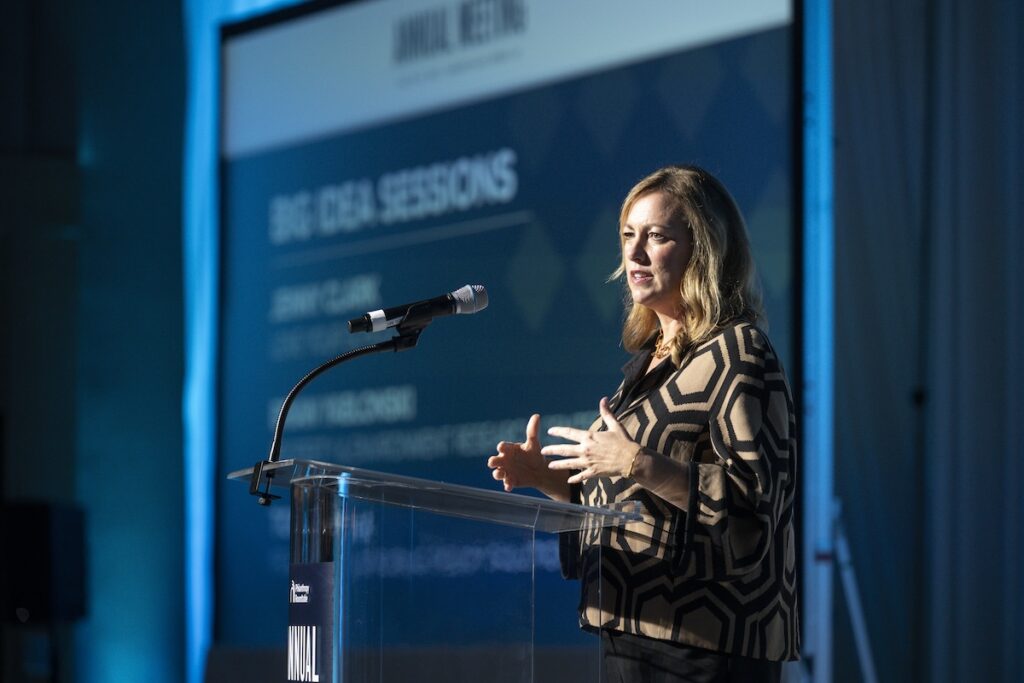
When Hanna Skandera Grady was named the organization’s president and CEO in late fall 2020, she reinforced that commitment.
“Bill Daniels’ vision and values are the heart of the daily mission of the Daniels Fund, and I am thrilled to have the opportunity to further his legacy and expand our impact,” she said.
For decades, the conversation around donor intent has largely centered on preservation: How can foundations ensure a donor’s wishes aren’t diluted or abandoned as leadership changes, institutions evolve and decades pass?
Skandera Grady makes it clear that giving parameters written into bylaws are not enough to achieve the vital goal of safeguarding donor intent.
But a different question is beginning to emerge: What if donor intent isn’t simply something to protect, but something foundations can use to drive innovation and impact? At Daniels Fund, Skandera Grady describes that idea as a move toward “Donor Intent 2.0″—shifting the emphasis from defense to offense.
“For too long, philanthropy has played defense with donor intent,” Skandera Grady says. “I think it’s time to play offense. The question isn’t only, ‘How do we keep from drifting?’ It’s ‘How can a founder’s vision propel us toward greater impact with deep purpose?’”
It’s a subtle but potentially important distinction for philanthropy. Traditional approaches to donor intent often emphasize safeguards: founding documents, governance structures, archives and institutional memory. Those mechanisms remain essential. But preservation alone doesn’t answer the harder question of how a foundation should respond to circumstances its founder could never have anticipated.
The challenge becomes even greater as time passes. Twenty-five years after a founder’s death, people may still remember how that individual thought and made decisions. Fifty or 100 years later, that personal knowledge will be gone. The goal, then, isn’t simply to preserve a founder’s words. It’s to preserve enough of the founder’s values, instincts and way of approaching problems that future generations can apply to new circumstances.
“The real test isn’t whether people who knew your founder understand the intent,” Skandera Grady says. “The test is whether someone 100 years from now—who never met that person—can still make a decision that unmistakably carries the founder’s DNA.”
From a founder’s instructions to a founder’s instincts
For Daniels Fund, that distinction is particularly relevant because its founder, cable television pioneer Bill Daniels, was an entrepreneur and risk-taker who wanted to create lasting change.
That presents an interesting paradox. A foundation can meticulously preserve an entrepreneurial founder’s legacy while gradually becoming less entrepreneurial itself.
“If your founder was an entrepreneur, the least faithful thing you can do is freeze the organization in time,” Skandera Grady says.
In that sense, fidelity requires understanding not only what a donor supported, but how and why that donor approached the world. Bill Daniels was willing to take risks and pursue ambitious ideas. Today, the foundation sees entrepreneurial grants, innovation and larger “Big Bets” as ways of expressing those qualities through contemporary grantmaking. With risk aversion a constant complaint of foundation critics, Daniels Fund promotes a brave alternative for philanthropy’s future.
In a nutshell, Skandera Grady emphasizes that the key is not just what a foundation is investing in – but why.
“The founders who built bold legacies generally weren’t cautious people,” she notes. “We shouldn’t turn bold entrepreneurs into cautious philanthropists after they’re gone.”
That philosophy turns donor intent from a set of boundaries into something closer to an institutional compass. The boundaries still matter. But within them, a foundation has room—and perhaps an obligation—to respond to a changing world.
“Donor intent shouldn’t make philanthropy less innovative,” Skandera Grady cautions. “Done right, it should give foundations the confidence to be more innovative, because they know exactly what they’re anchored to.”
Making legacy part of the operating system
The distinction also changes how a foundation institutionalizes donor intent.
At Daniels Fund, Bill Daniels’ values and desired outcomes aren’t treated solely as historical material. Grantmaking strategies explicitly connect to the foundation’s bylaws and desired outcomes. New associates receive a legacy orientation, stories about Daniels and his decision-making are regularly shared across the organization and donor-intent alignment has been incorporated into surveys and individual performance goals. The foundation also begins board meetings with legacy and donor-intent guardrails and uses storytelling to connect Daniels’ generosity with the lives affected by the foundation’s work today.
“A founder’s legacy shouldn’t live in a binder,” Skandera Grady says. “It’s not enough to just capture a founder’s mind. We have to capture the heart and the values behind those thoughts.”
That requires translating institutional memory into a living practice.
“Stewarding donor intent doesn’t mean using the same napkins Bill used at an event in 1980,” she explains. “It means understanding him well enough to know what mattered—and having the courage to apply those principles to a world he never saw.”
That simple example reflects a serious challenge. Foundations can faithfully preserve the artifacts and traditions surrounding a founder while slowly drifting from the principles that actually mattered to that person. Many of the nation’s famous foundations have allowed that drift. Daniels Fund’s approach is to make donor intent something employees encounter repeatedly—in strategy, culture, grantmaking and accountability—rather than something consulted only when a difficult question arises.
Skandera Grady is mindful of one of the most important lessons learned by the Daniels Fund – the people charged with implementing the founder’s wishes on a daily basis are critical to protecting donor intent.
“People are policy and people are who preserve a founder’s legacy,” she says. “Without people in place who are aligned with the founder’s values and vision, what’s simply written on paper can become far more flexible than originally intended.”
At the Daniels Fund, she adds, “Donor intent is built into the people, systems, culture and accountability of the organization so it can’t quietly disappear.”
Could technology keep a founder’s voice in the room?
The next frontier may be technology.
Daniels Fund is envisioning an AI-enabled donor-intent tool that could make Daniels’ letters, quotes, stories, decisions and philanthropic legacy accessible within the systems employees already use. Rather than functioning simply as a searchable archive, the aspiration is for that accumulated knowledge to inform live decisions in areas such as grant due diligence, scholarship selection and communications.
“Imagine being able to bring decades of a founder’s letters, stories, decisions and instincts into the moment when a grant decision is actually being made,” Skandera Grady says. “That’s much more powerful than an archive people have to remember to visit.”
Such technology wouldn’t eliminate judgment. If anything, it could make human judgment more demanding by giving future decision makers richer context about the person whose intent they are charged with stewarding.
And that leads to a different kind of donor-intent question.
“I don’t want our team asking only, ‘Would Bill approve of this?’” Skandera Grady says. “I want them asking, ‘Would Bill have seen this opportunity coming—and what would he build next?’”
That question captures the larger evolution Daniels Fund is pursuing. Its own working materials describe donor intent as a “living legacy”—one renewed through the foundation’s work rather than confined to the past.
From guardrails to a living legacy
None of this eliminates the traditional responsibilities surrounding donor intent. Governance protections, clear grantmaking strategies, due diligence and vigilance against donor drift remain critical. Indeed, Daniels Fund’s approach relies heavily on those structures.
But those protections are just the beginning of stewardship rather than its endpoint.
The broader challenge for philanthropy is to preserve enough of a founder’s character, heart and values—not simply his or her instructions—that an institution can continue making relevant decisions generations later.
For foundations established by entrepreneurs, innovators and other agents of change, that distinction may be particularly important. Treating donor intent as fragile can inadvertently produce institutions more cautious than the people who created them. The alternative is a more dynamic conception: donor intent as an enduring source of institutional identity, discipline and permission to act.
“A living legacy isn’t about recreating yesterday,” Skandera Grady says. “It’s about carrying the best of your founder forward and having the courage to apply it to tomorrow.”
